CareNestHQ™ Start Your Care Space
Shared ownership

One sibling shouldn't have to carry the entire responsibility

A simple family care handoff system helps siblings divide responsibilities, improve communication, and reduce caregiver burnout. Build your care team, then download the worksheet that makes assignments visible to everyone.

  • Share responsibilities
  • Coordinate siblings
  • Reduce confusion
  • Free printable worksheet
Adult siblings gathered at a kitchen table with a calendar, medication list, and notebook while one sibling leads a family care conversation
A familiar pattern

Why Families Drift Apart

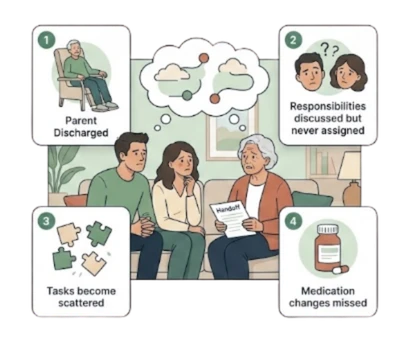
Answer: Sibling care breaks down when responsibilities are discussed but never assigned. A written handoff prevents the missed appointments and duplicate calls that follow.

Why Families Drift Apart timeline showing how caregiving responsibilities become scattered when families do not have a shared care coordination process.
A simple weekly family check-in helps prevent missed responsibilities and keeps everyone aligned.
  1. Step 1

    Parent discharged

  2. Step 2

    Everyone assumes someone else is helping

  3. Step 3

    Tasks become scattered

  4. Step 4

    Medication changes missed

  5. Solution

    Weekly check-ins restore clarity

“Families don't fail because they don't care. They fail because nobody owns the process.”

Root causes

Why Siblings Struggle With Shared Care

Answer: Most sibling conflict is not about love. It is about unclear systems — schedules, distance, and missing ownership.

Different schedules

Work, children, and travel make simultaneous availability rare without a planned meeting time.

Example: One sibling can only talk after 8 p.m.; another is free only on Sunday mornings.

How to fix it: Set one recurring weekly check-in on the calendar.

Living in different cities

Distance amplifies information gaps when updates live in one person's memory or phone.

Example: A sister in Arizona learns about a specialist visit three days after it happened.

How to fix it: Assign remote siblings phone-based tasks with due dates.

Poor communication

Group texts mix urgent clinical details with casual check-ins. Nobody knows what is current.

Example: A medication change gets buried between photos and dinner plans.

How to fix it: Name one family communicator for written updates.

Different expectations

One sibling expects daily updates. Another thinks weekly is enough. Neither states the expectation aloud.

Example: A brother feels ignored while his sister thought weekly texts were plenty.

How to fix it: Agree on update frequency during the weekly check-in.

Unequal workloads

The sibling who lives closest often becomes the default owner of every task, seen and unseen.

Example: The local sibling handles every pharmacy run while others wait to be asked.

How to fix it: Divide by category, not by proximity alone.

Decision fatigue

One person makes dozens of small calls each week while others wait to be asked.

Example: One sibling books every appointment while others assume the calendar is handled.

How to fix it: Assign specific deliverables to each sibling by name.

No ownership

Tasks are discussed in conversation but never assigned to a name with a due date.

Example: “Someone should call insurance” ends the conversation with no named owner.

How to fix it: End every meeting with one owner per action item.

No backup plan

When the primary caregiver travels or burns out, nobody knows which tasks to pick up.

Example: When the primary caregiver travels, refills stall because no backup was named.

How to fix it: Name a backup owner for every recurring task.

Caregiver burnout often starts here: not with a single crisis, but with one sibling becoming the human API for every portal, pharmacy call, and ER question. Named roles with backups change that default.

Signature framework

Build A Family Care Team

Answer: Divide work by category, not by whoever happens to be in the room. Assign a primary owner, backup, and review schedule for each role.

Primary Caregiver

Responsibilities
Daily supervision, in-home care coordination, and first response to symptoms or changes.
Typical weekly duties
Observe daily health, flag changes, and prepare the weekly summary for siblings.
Example tasks
Check blood pressure log, confirm home health visit, note appetite or mobility changes.

Medication Coordinator

Responsibilities
Master medication list, refills, pill organizer, and reconciliation after visits.
Typical weekly duties
Compare pill bottles to the master list and report any starts, stops, or dose changes.
Example tasks
Call pharmacy for refills, update list after cardiology visit, set refill reminders.

Appointment Coordinator

Responsibilities
Scheduling, reminders, transport, and preparing questions for each visit.
Typical weekly duties
Confirm upcoming visits, arrange rides, and send a written summary after each appointment.
Example tasks
Book cardiology follow-up, confirm home health start date, email visit notes to siblings.

Family Communicator

Responsibilities
Written sibling summary, weekly check-in agenda, and keeping remote siblings aligned.
Typical weekly duties
Send one consolidated update and capture action items with named owners.
Example tasks
Email Sunday summary, post check-in notes, remind siblings of assigned tasks.

Emergency Contact

Responsibilities
ER escalation list, 911 protocol, and who notifies siblings during a crisis.
Typical weekly duties
Confirm emergency card is current and every sibling knows the escalation order.
Example tasks
Update refrigerator card, test sibling phone tree, post hospital bag checklist.

Document Manager

Responsibilities
Scanning discharge papers, HIPAA forms, insurance cards, and portal access.
Typical weekly duties
File new clinical papers and confirm every sibling can access the shared folder.
Example tasks
Scan specialist notes, upload insurance card, track signed HIPAA releases.

When a role has no primary name, that task is an unmanaged risk. Use the Family Responsibility Matrix for a deeper framework, or download the worksheet below to formalize assignments in one sitting.

Stay coordinated

The 15-Minute Weekly Family Check-In

A simple weekly conversation helps families stay aligned, catch problems early, and avoid confusion before small issues become emergencies.

Health Review

2 min

Compare notes on how your parent is doing before the week gets busy.

  • How are they feeling?
  • Any new symptoms?
  • Any recent falls?
  • Any concerns?

Medications

2 min

Confirm the master list matches what is in the pill organizer and pharmacy records.

  • New prescriptions
  • Refill needs
  • Side effects
  • Missed doses

Appointments

3 min

Review the week ahead so transport and follow-up items are covered.

  • Upcoming visits
  • Transportation
  • Follow-up items
  • Questions for providers

Care Tasks

2 min

See what got done, what slipped, and who should pick up new work.

  • Completed
  • Overdue
  • New responsibilities
  • Reassign work

Important Documents

2 min

Confirm critical paperwork is current and every sibling can access it.

Family Communication

2 min

Make sure remote siblings are not guessing from scattered texts.

  • Everyone informed?
  • New caregivers?
  • Scheduling conflicts?
  • Questions?

Plan Next Week

2 min

End with named owners so the next week starts with clarity.

  • Who owns what?
  • Upcoming appointments
  • Shopping and errands
  • Follow-up calls

Total: Approximately 15 minutes.

End every check-in with named action items, not vague intentions. Send a written summary within 24 hours so remote siblings stay aligned.

For the full fifteen-minute medical review agenda, see Medical Administration Weekly Checklist. For operating rhythm after month one, see Weekly Care Operations Review.


Avoid these gaps

Common Mistakes Families Make

Answer: Most handoff failures come from proximity defaults, unassigned tasks, and plans that never get updated.

Everyone assumes someone updated the medication list

Old information gets shared

Assign one medication owner

One sibling does everything

Proximity becomes permanent default unless roles are written down

Assign six named roles with primary and backup owners

Nobody owns follow-up

“Someone should call the insurance company” is not an assignment

Name one owner and one due date for every open task

Tasks discussed but never assigned

Conversation feels productive but nothing changes after the call ends

End every meeting with a short task list and owners

Family relies on memory

Clinical details drift. Siblings recall different versions of the same visit

Use a shared worksheet and written summaries after every change

Plan never gets updated

Hospital stays, moves, and availability shifts make the old plan wrong

Review the handoff after every medical event and monthly otherwise

Communication only during emergencies

Reactive calls scramble siblings who do not know current medications or contacts

Run a weekly check-in rhythm before the next crisis

Best practices

Practical Systems Beat Good Intentions

Answer: Repeatable coordination beats heroic effort. Replace informal workarounds with named owners and a shared rhythm.

The National Institute on Aging recommends regular family communication for distributed caregivers. A handoff worksheet turns that advice into visible ownership every sibling can reference.

Without system With CareNestHQ
Group texts Care Updates
Sticky notes Shared Tasks
Paper calendars Shared Appointments
Memory Medication List

Pair role assignments with the Family Command Center for one shared place to track tasks, and with Family Recovery Coordination for the first 72 hours after discharge.

Real family example

How One Family Got Aligned

Susan lives in Arizona. Her brother visits Dad every Tuesday. Their sister handles insurance. Each wanted to help — but nobody had a clear picture of who owned what.

Before

Nobody knew who owned appointments. Medication changes reached Susan days late. Her brother felt like the default owner of every in-person task.

After

Every Sunday evening they spend 15 minutes reviewing:

  • Appointments
  • Medications
  • Tasks
  • Family updates
FREE DOWNLOAD

Sibling Care Handoff Worksheet

Most families complete the first draft in about thirty minutes during a family call. Print one copy for the caregiver binder and save a scan in your shared folder.

  • Printable
  • 15-minute meeting guide
  • Family planning worksheet
  • Reuse every week
Common questions

Frequently Asked Questions

How should siblings divide responsibilities?

List every recurring task and name one primary owner and one backup for each.

Post the plan where every sibling can see it. Match roles to skills and availability rather than proximity alone.

What if one sibling lives far away?

Remote siblings can own insurance calls, research, document management, and written family updates.

Confirm HIPAA authorization includes their name and grant shared folder access. See Long Distance Caregiving for the full remote playbook.

How often should responsibilities be reviewed?

Review assignments after every hospital stay and at least monthly during stable periods.

Update the handoff worksheet whenever someone cannot continue in a role.

What if siblings disagree?

Start with the healthcare proxy and advance directives your parent signed.

Use assigned roles so disagreements become task conflicts, not information hoarding.

Who should lead family meetings?

The family communicator or appointment coordinator is a good default.

Rotate leadership if the primary caregiver needs relief. One person keeps time and sends the written summary.

Should every task have a backup owner?

Yes — when the primary owner is unavailable, the backup should step in without a scramble.

Blank backup fields are unmanaged risk.

How do we handle emergencies?

Document who calls 911, who phones the hospital, who notifies siblings, and who travels.

Post the escalation list beside your emergency medical card.

What if one sibling stops helping?

Reassign their tasks immediately on the handoff worksheet.

Do not let responsibilities sit unowned. Discuss capacity openly in the weekly check-in rather than letting resentment build.

Get started

Build one weekly habit that keeps your family connected.

Coordinate medications, appointments, documents, and family responsibilities from one secure place.

  • Secure
  • Family focused
  • Easy to use
  • Free to start