Outdated medication lists
Compare master list to pill bottles every week
Everyone uses the same dose information
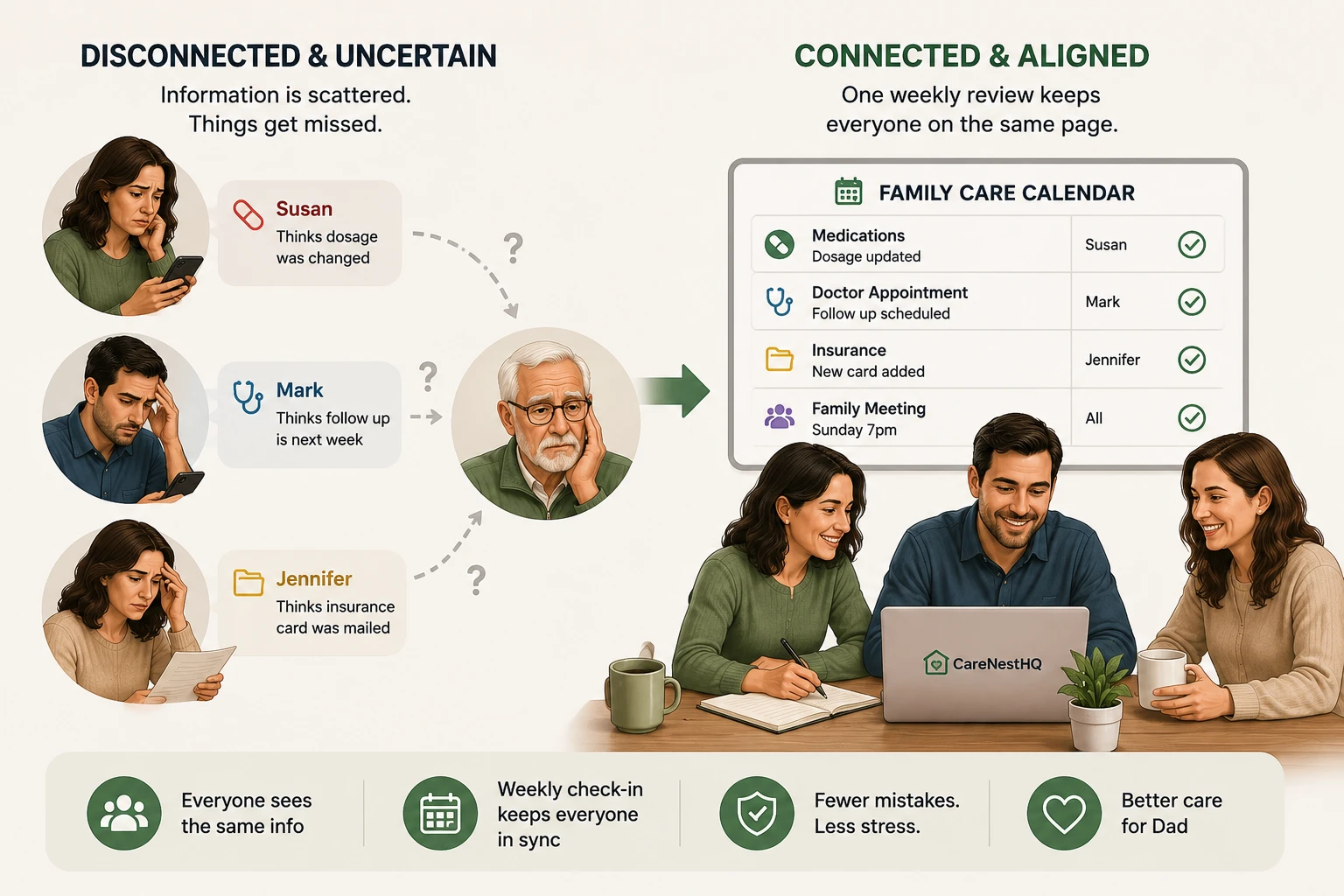
A weekly family care review keeps medications, appointments, and responsibilities accurate before small problems become emergencies. Learn how to run the meeting, then download the checklist that makes it repeatable.
Answer: Siblings often coordinate in good faith but lack a shared rhythm for comparing notes before the week runs away from them.
Medication changed
Nobody tells siblings
Old medication list used
Family discovers conflicting information
Weekly review prevents confusion
Answer: Organizing medical information is not a one-time project. Without a weekly touchpoint, even careful families drift into conflicting versions of the truth.
Outdated medication lists
Compare master list to pill bottles every week
Everyone uses the same dose information
Missed appointments
Review the next seven to fourteen days on one calendar
Rescheduled visits reach every sibling
Conflicting information in group texts
Send one written summary after each review
One source of truth replaces scattered threads
Tasks discussed but never assigned
End every meeting with named owners and due dates
Work gets done instead of assumed
Answer: Run the same five steps every week. One person keeps time. Another captures action items. End with named owners, not vague good intentions.
Compare master list to pill bottles and any changes since last week. Confirm nothing started, stopped, or changed dose without the family knowing.
Confirm dates, transport, and who attends in the next seven to fourteen days. Flag any rescheduled visits that did not reach all siblings.
Scan discharge papers, lab results, and specialist notes into the shared folder. Refresh the emergency medical card when medications or contacts change.
Insurance calls, prescription refills, equipment orders, and home health follow-ups. Close completed items and carry forward anything still open.
Name one owner per task for the coming week and send a written summary within 24 hours. Unassigned tasks default to the primary caregiver.
For a deeper operations framework after discharge, see Weekly Care Operations Review. For role assignment before your first meeting, use the Family Responsibility Matrix.
Answer: Follow this flow during the meeting. Not every item needs discussion every week, but scan each category before you adjourn.
Mood, mobility, appetite, sleep, and new symptoms worth mentioning at the next provider visit.
Upcoming visits, telehealth links, transportation needs, and post-visit notes still owed to siblings.
Active prescriptions, dose changes, refills due, and over-the-counter drugs added since last review.
Confirm what got done since last week. Celebrate progress and close the loop on finished items.
Insurance prior authorizations, equipment orders, referrals, and home health follow-ups for the coming week.
Phone numbers, proxy documents, and ER refrigerator card accuracy.
Open items from siblings who could not attend. Clarify before anyone acts on assumptions.
Top three to four deliverables for the coming week. Name one owner and one due date per action item.
Answer: You do not need every relative on every call. You need the people who own medical tasks and the siblings who need accurate updates.
Brings ground truth on daily medications, symptoms, and appointments.
Weekly contribution: Reports what changed since last review and flags anything urgent.
Every child who coordinates care needs the same facts, even part-time.
Weekly contribution: Attend live or read the written summary within 24 hours.
Distance amplifies information gaps when updates live in one person's phone.
Weekly contribution: Join by video and take assigned phone-based follow-ups. See Long Distance Caregiving.
Must know current medications and contacts if a crisis happens between reviews.
Weekly contribution: Confirm ER card and escalation list stay current.
Geriatric care managers or paid advocates hold clinical context the family may lack.
Weekly contribution: Share observations from home visits or provider calls when applicable.
Decision-maker if your parent cannot speak for themselves during a medical event.
Weekly contribution: Stay aligned on treatment preferences and advance directive updates.
Who owns follow-up: The meeting leader sends a written summary within 24 hours. Every action item names one owner and one due date. Unassigned tasks default to the primary caregiver, which is how burnout starts.
Answer: Crisis-driven calls are reactive. Weekly reviews catch drift before it becomes an emergency.
❌ Nobody updates medication changes
Conflicting information across siblings and providers
✅ Review medications every Sunday
❌ Meeting only after problems occur
Reactive scramble instead of planned coordination
✅ Same day and time every week
❌ Nobody takes notes
Absent siblings work from memory or group texts
✅ Send written summary within 24 hours
❌ No one owns action items
“We should call the pharmacy” never becomes a plan
✅ Name one owner per task before adjourning
❌ Lists compared to old discharge summary
Missed dose changes from recent specialist visits
✅ Compare against pill bottles each week
❌ No follow-up meeting scheduled
Good intentions fade before the next busy week
✅ Put next review on the calendar before hanging up
Answer: Consistent family communication is one of the strongest predictors of smoother post-discharge recovery.
The National Institute on Aging recommends regular check-ins for distributed families. A structured fifteen-minute review turns good intentions into shared facts. This guide focuses on practical organization, not medical or legal advice.
Spot medication drift, missed appointments, and forgotten follow-ups before they become crises.
Remote and local siblings work from the same written summary instead of scattered texts.
Anchor the meeting to a recurring calendar invite so the habit survives busy weeks.
Clear ownership prevents one sibling from becoming the human API for every update.
Use this printable companion after you understand the five-step review above. Most families complete their first guided review in about fifteen minutes.
Updated PDF coming soon. Use the weekly medical admin workflow in our organizing guide while we rebuild this checklist as a premium authority asset.
Answer: Build your family medical system step by step — from emergency information through weekly reviews to ongoing coordination.
Susan lives in Arizona. Her brother visits Dad every Tuesday. Their sister manages medications.
Organize your family, review medications, track appointments, and stay prepared before emergencies happen.
Once per week at the same day and time.
Most families choose Sunday evening or Monday morning. Consistency matters more than duration.
The appointment coordinator or family communicator is a good default.
Rotate if the primary caregiver needs relief. One person keeps time and captures action items.
Block fifteen minutes.
If you consistently need longer, assign more roles using the sibling care handoff worksheet or family responsibility matrix.
Run the meeting by video call.
Share your screen on the shared medication list and calendar. Send a written summary the same day to siblings who could not attend live.
Compare the master list against pill bottles each week.
You do not need to read every dose aloud, but confirm nothing started, stopped, or changed without the family knowing.
Scan new clinical papers into your shared folder during the review.
Refresh the emergency medical card when medications or contacts change.
Yes — video works well for distributed families.
Keep a shared agenda visible, mute side conversations, and end with named owners for every action item.
Send a written summary within 24 hours.
List medication changes, upcoming appointments, and assigned tasks. Missing siblings should not rely on a group text thread for clinical details.