Inputs
- Discharge task list
- Family roster
- Remote and local availability split
 Start Your Care Space
Every task has one owner and one backup. Blank rows become midnight phone calls. Expert families hold a 48-hour post-discharge call, read discharge tasks aloud, and assign owners live — converting vague availability into deliverables with due dates.

Blank rows become midnight phone calls. Expert families hold a 48-hour post-discharge call, read discharge tasks aloud, and assign owners live — converting vague availability into deliverables with due dates.
Quick answer: Assign one primary and one backup owner to each recurring care domain: appointments, medications, insurance and documents, and family communication. Remote siblings own phone-based tasks; local caregivers own physical care execution.
The Family Responsibility Matrix™ is a single sheet where every recurring post-discharge task — medications, appointments, insurance, family updates — has one primary owner and one confirmed backup.
Without named ownership, siblings assume someone else booked the cardiology follow-up or called the pharmacy about a new prescription. Two people schedule the same specialist; nobody owns insurance authorization — and the local caregiver absorbs the fallout.
Proximity bias makes this worse: the sibling who lives nearest becomes the default owner for every task, while remote siblings offer emotional support without assigned deliverables. The matrix ends ambiguity by requiring two names on every row.
Purpose: Eliminate ambiguous ownership across siblings and caregivers
| Layer | Typical owner | Example deliverables |
|---|---|---|
| Appointments & follow-through | Remote primary | Book PCP within 7 days; confirm home health start date |
| Medications & daily recovery | Local primary | Administer daily meds; confirm pharmacy pickup same day |
| Insurance & documents | Remote primary | Prior authorization calls; upload discharge summary |
| Family updates & escalation | Rotating lead | Weekly written update; broadcast during incidents |
| Domain | Rebecca (local) | Mike (remote) | Susan (remote) |
|---|---|---|---|
| Appointments | Attends PCP visit | Books cardiology | Calendar owner |
| Medications | Daily administration | Refill phone calls | Master medication list |
| Insurance | Backup | Prior auth primary | Document uploads |
| Family updates | Backup | Backup | Weekly update lead |
The Martinez family completed this matrix on a 48-hour post-discharge call. Mike stopped daily check-ins without tasks and instead owned three remote deliverables with due dates — resolving the Switchboard Trap.
Symptom: Two siblings book the same specialist appointment
System fix: Assign one appointment owner per provider with backup confirmation in writing
Symptom: New prescription sits unfilled because nobody owned the pharmacy call
System fix: Add medication refill row with remote primary and local backup on pickup
Symptom: One sibling holds all physical and administrative tasks
System fix: Redistribute phone-based layers to remote siblings with named due dates
Symptom: Backup column left blank on critical rows
System fix: Require backup acknowledgment within 24 hours before matrix is final
| Surface | Implementation |
|---|---|
| 48-hour assignment call | Read discharge tasks aloud; assign primary and backup live on the matrix |
| Worksheet Page 2 | Use the Family Care Coordination Worksheet matrix section for the Rebecca/Mike/Susan worked example |
| CareNestHQ tasks | Require owner and backup fields on medications, appointments, and recurring tasks |
| Long-distance article | Align remote vs local split with Long Distance Caregiving guidance |
| Failure diagnosis | Use the Caregiver Failure Model™ to identify Switchboard Trap before rebuilding the matrix |
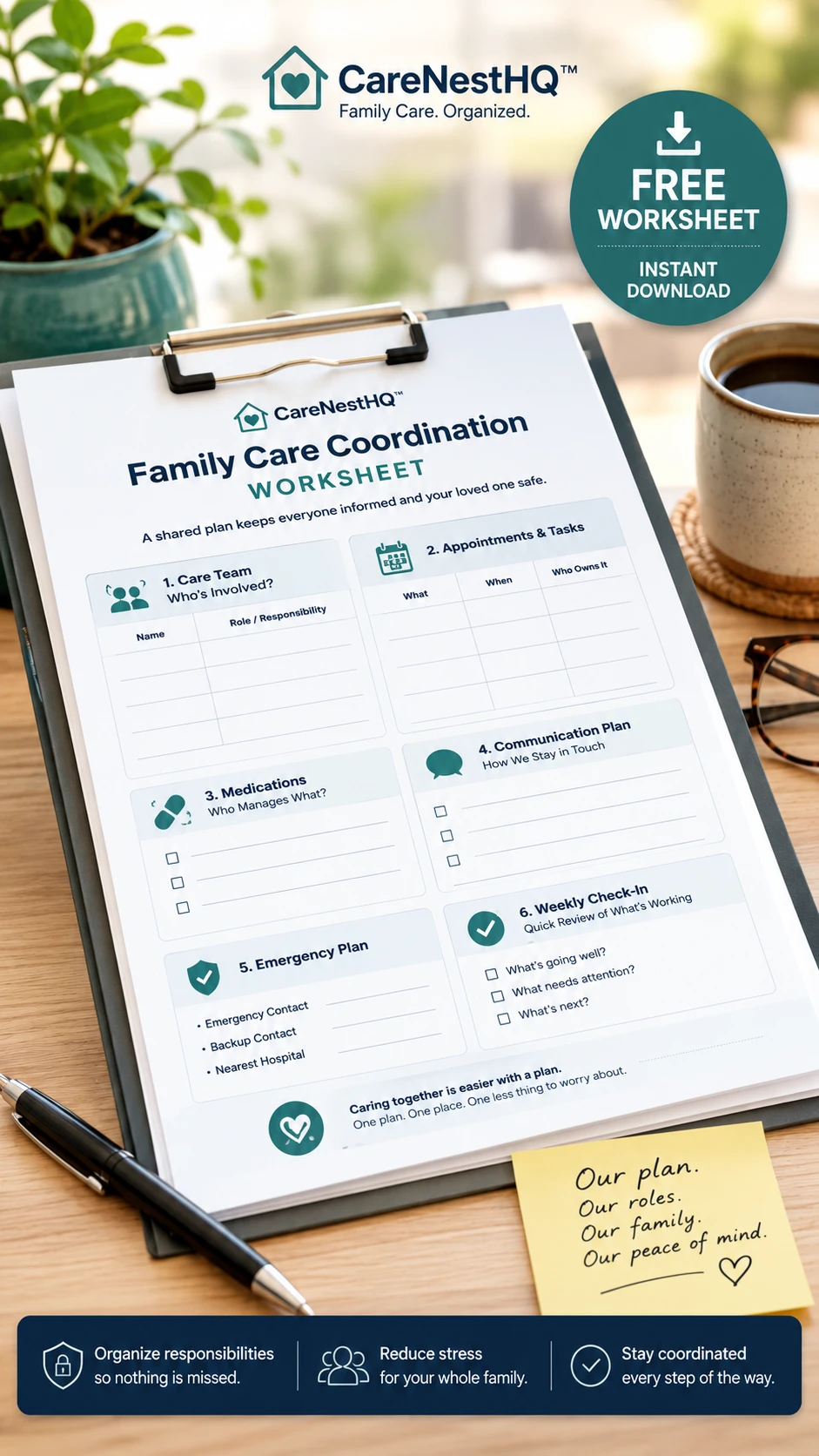
Printable worksheet for family roles, emergency contacts, medication ownership, appointment ownership, weekly planner, and escalation rules after hospital discharge.
See also the Family Medical Information Readiness Report 2026 for baseline preparedness data.
Permanent CareNestHQ intellectual property framework for family care coordination.
PublishedPermanent CareNestHQ intellectual property framework for family care coordination.
PublishedPermanent CareNestHQ intellectual property framework for family care coordination.
PublishedPermanent CareNestHQ intellectual property framework for family care coordination.
PublishedPermanent CareNestHQ intellectual property framework for family care coordination.
PublishedPermanent CareNestHQ intellectual property framework for family care coordination.
PublishedPermanent CareNestHQ intellectual property framework for family care coordination.
A family responsibility matrix is a structured document assigning one primary owner and one backup to each recurring caregiving task after hospital discharge.
Local siblings typically own physical care execution; remote siblings own phone-based tasks like scheduling, insurance calls, and document management.
Primary owners miss tasks when sick, traveling, or overwhelmed. A confirmed backup prevents single points of failure without emergency renegotiation.
Within 48 hours of discharge, before the 72-Hour Recovery Protocol windows close.
Every recurring task: medication administration, refill calls, appointment booking, insurance authorization, home health coordination, and family update leadership.
The matrix is the assignment layer inside the Care Coordination Operating System.
Yes, but watch for Hero Local overload. Redistribute phone tasks to remote siblings when the local primary exceeds sustainable load.
CMS transition-of-care programs and AHA caregiver guidance emphasize clear role definition and follow-up ownership to reduce readmission risk.