Inputs
- Discharge plan
- Family roster
- Local and remote availability
 Start Your Care Space
One system for how families run care. Families fail at caregiving not from lack of love but from lack of operating system. CCOS replaces ad hoc caregiving — where every week rebuilds the plan from memory — with a documented, repeatable coordination architecture.
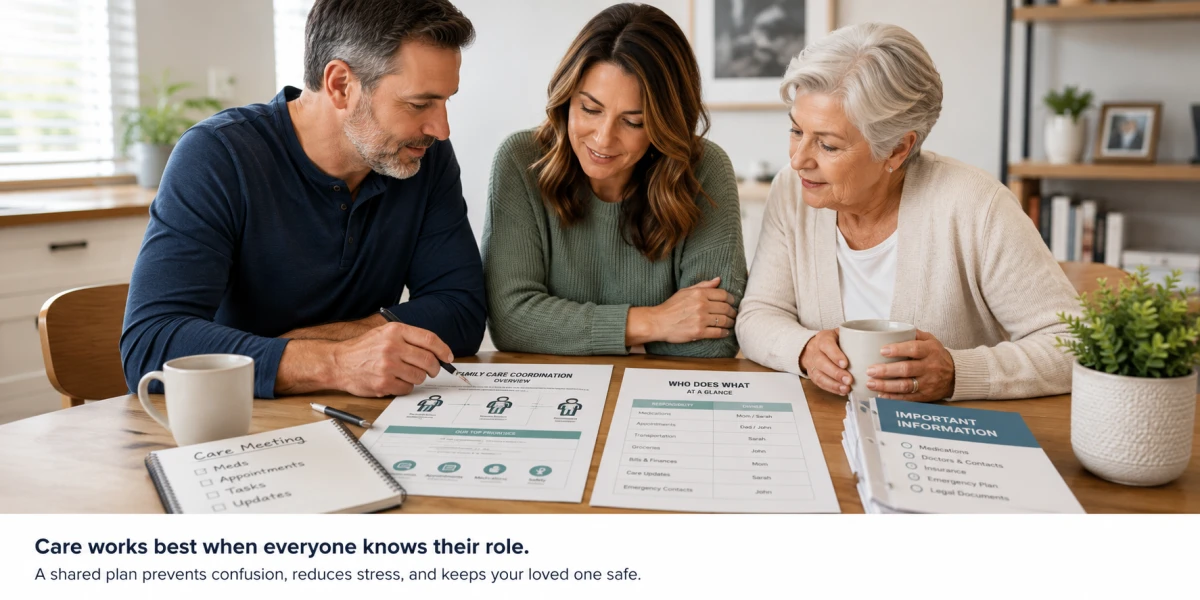
Families fail at caregiving not from lack of love but from lack of operating system. CCOS replaces ad hoc caregiving — where every week rebuilds the plan from memory — with a documented, repeatable coordination architecture.
Quick answer: A family care coordination operating system assigns clear task ownership, establishes one communication rhythm, runs a weekly operations review, and pre-decides emergency escalation — so post-discharge care runs on structure, not heroics.
The Care Coordination Operating System™ (CCOS) is the meta-framework that defines how a family runs care: who owns what, how they communicate, how they review weekly, and how they escalate emergencies — as one coherent system.
After hospital discharge, most families operate without a shared system. The local sibling absorbs physical care while remote siblings call daily without owning deliverables. Medications, appointments, and insurance tasks duplicate or vanish because nobody documented who owns what.
Clinical discharge instructions describe medical requirements; they do not assign family execution roles. Without an operating system, good intentions produce burnout, missed follow-ups, and preventable readmissions — not because the family does not care, but because coordination was never designed.
Purpose: Unify assignment, communication, review, and escalation into one repeatable system
CCOS organizes family care into four operational layers. Clinical guidance from the medical team sits at the top; family execution flows through assignment, communication, and review before reaching emergency escalation.
| Layer | Framework | Function |
|---|---|---|
| Assignment | Family Responsibility Matrix™ | One primary and one backup owner per recurring task |
| Communication | Family Command Center™ | Weekly rhythm, one channel, pre-assigned escalation |
| Review | Weekly Care Operations Review™ | Structured stand-up that prevents plan drift |
| Emergency | Emergency Escalation Matrix™ | Scenario-based who-acts-who-notifies decisions |
Martinez family — post-cardiac discharge: Rebecca (local) owns daily medication administration and home health coordination. Mike (remote) owns specialist scheduling and insurance authorization calls. Susan (remote) leads the Family Command Center — Sunday 4 p.m. video stand-up and written updates to all siblings.
On discharge day, the family introduced CCOS on a group call: "We are running a care operating system, not winging it." Within 48 hours they completed the Family Responsibility Matrix™, launched the 72-Hour Recovery Protocol™, and scheduled their first weekly review.
Symptom: Every Monday starts with re-deciding who handles what
System fix: Document CCOS on discharge day and assign matrix owners before week one ends
Symptom: Discharge summary exists but no family execution roles
System fix: Translate clinical tasks into matrix rows with primary and backup names
Symptom: Daily check-ins add status requests without removing tasks
System fix: Pair FCC cadence with FRM deliverables so calls produce owned outcomes
Symptom: Strong first 72 hours decay into week-four chaos
System fix: Transition from 72H Protocol to Weekly Care Operations Review on day eight
| Surface | Implementation |
|---|---|
| Discharge day call | Name CCOS explicitly; introduce sub-frameworks and assign a documentation owner |
| Family Care Coordination Worksheet | Download the Family Care Coordination Worksheet to capture matrix, command center, and review fields in one printable asset |
| CareNestHQ app onboarding | Set up your Care Coordination Operating System with layer status indicators on the dashboard |
| Cluster hub | Anchor CCOS narrative in Family Recovery Coordination and Long Distance Caregiving |
| Readiness measurement | Track system maturity with the Care Readiness Score™ after 30 days of operation |
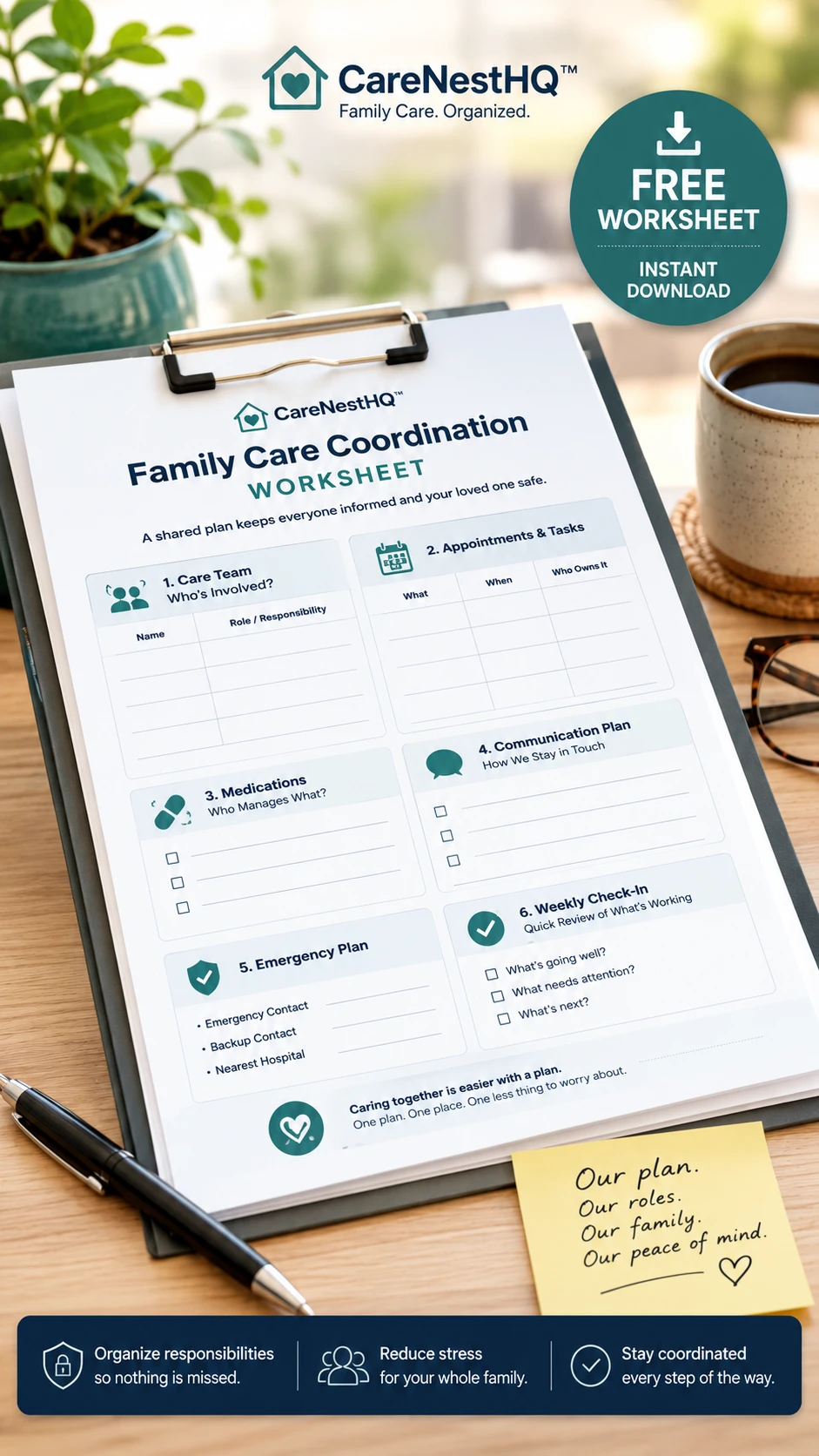
Printable worksheet for family roles, emergency contacts, medication ownership, appointment ownership, weekly planner, and escalation rules after hospital discharge.
See also the Family Medical Information Readiness Report 2026 for baseline preparedness data.
Permanent CareNestHQ intellectual property framework for family care coordination.
PublishedPermanent CareNestHQ intellectual property framework for family care coordination.
PublishedPermanent CareNestHQ intellectual property framework for family care coordination.
PublishedPermanent CareNestHQ intellectual property framework for family care coordination.
PublishedPermanent CareNestHQ intellectual property framework for family care coordination.
PublishedPermanent CareNestHQ intellectual property framework for family care coordination.
PublishedPermanent CareNestHQ intellectual property framework for family care coordination.
A care coordination operating system is the documented set of rules a family uses to assign tasks, communicate, review progress weekly, and escalate emergencies — treating home care as operations rather than improvisation.
A discharge checklist captures one-time tasks at transition. CCOS is the ongoing system that sustains coordination after the checklist is complete, including weekly reviews and emergency protocols.
Remote siblings benefit most from CCOS because it converts proximity guilt into assigned deliverables — scheduling, insurance, documents — with clear due dates.
Ideally on discharge day or within the first 72 hours. Delaying system setup allows failure patterns like the Switchboard Trap to become habits.
CCOS contains the Family Responsibility Matrix, Family Command Center, 72-Hour Recovery Protocol, Emergency Escalation Matrix, Weekly Care Operations Review, and is measured by the Care Readiness Score.
Yes. Families can run CCOS with the printable Family Care Coordination Worksheet. The CareNestHQ app adds reminders, shared records, and readiness scoring.
Track matrix completion, time to first assigned owner, weekly review adherence, and Care Readiness Score delta over 30 days.
CMS care-transition guidance, AHA caregiver resources, and NIA aging research all emphasize structured family involvement after hospital discharge.