Family Care Coordination

Hospital Discharge Care Planning: A Family Coordination Guide

Most families focus on getting their parent home safely from the hospital. The harder challenge is what happens next, and who in your family is responsible for each part of it. This guide gives your family a clear plan for the first 72 hours after discharge, a structured 30-day coordination framework, and the tools to make sure nothing falls through.

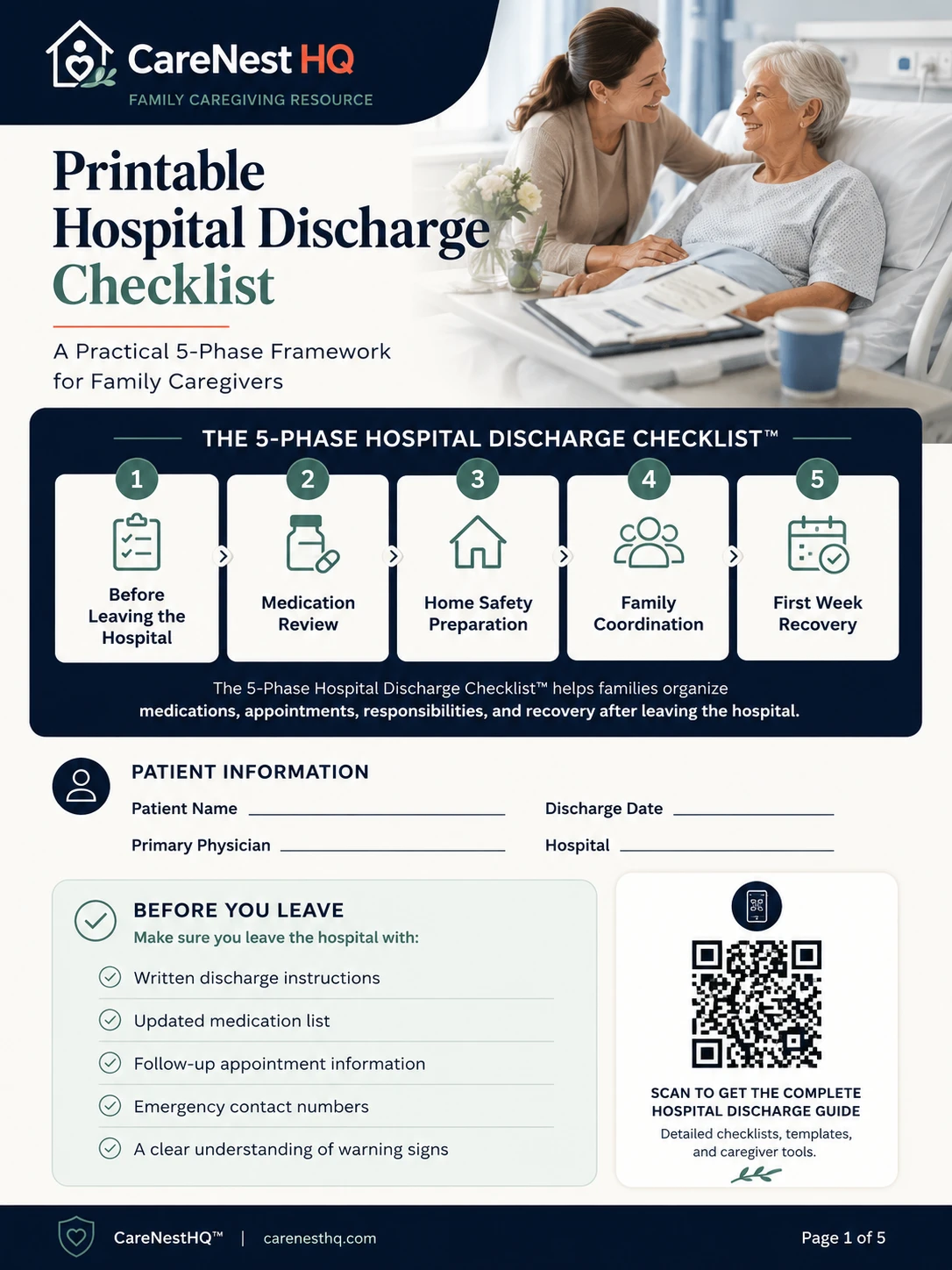
Download the Hospital Discharge Planner
Family coordinating hospital discharge care plan at home

What this guide helps your family do

  • Organize the first 72 hours after discharge
  • Assign responsibilities to named family members
  • Track medications, appointments, documents, and updates
  • Use the 30-day Recovery Coordination System

The Hospital Gets Your Parent Ready to Leave. Your Family Has to Figure Out the Rest.

The hospital's job ends at discharge. Your family's job begins.

That is not a criticism of hospitals. It is how the system works. Hospitals are designed to stabilize patients and move them to the next level of care. What happens after the doors close, including the medications, the appointments, the daily check-ins, and the family care coordination across siblings in three different cities, falls to you.

Most discharge instructions are written for medical professionals, not family coordinators. They are thorough on clinical detail and almost silent on the coordination question every family actually faces: who does what, starting now?

Coordination, not clinical care, drives most post-discharge problems

A classic study found that nearly 20% of patients experience adverse events within three weeks of discharge, nearly three-quarters of which could have been prevented or ameliorated. Adverse drug events are the most common complication. But the underlying driver is rarely purely clinical. Systematic problems in care transitions are at the root of most adverse events that arise after discharge.

In other words: most post-discharge problems are coordination problems. And coordination is a family responsibility, not a hospital one.

According to AARP and the National Alliance for Caregiving's 2025 report, there are now 63 million family caregivers in the United States, roughly one in four American adults. Over 40% provide high-intensity care, yet only 22% receive any training. The gap between what families are asked to manage and what they are prepared to manage is widest in the days immediately after a hospital discharge.

The gap in most guides

Why Most Hospital Discharge Guides Fall Short

There is no shortage of hospital discharge guides. Most hospitals provide them. Dozens of organizations publish them. They cover discharge checklists, medication lists, and follow-up appointment reminders. Most of them fall short for the same three reasons.

They focus on the patient, not the family

Most discharge guides explain what the patient needs to do. Few address what the family needs to do, specifically, how multiple people with different levels of information, living in different places, coordinate shared caregiving responsibilities after their parent comes home.

Family care coordination after hospital discharge is not a patient-education problem. It is a family-organization problem.

They focus on discharge day, not the next 30 days

Approximately 20% of Medicare beneficiaries experience readmission within 30 days of discharge. The overwhelming majority of those events happen in week two and week three, when urgency has faded and routines are still fragile.

Discharge-day checklists do not address what families need in weeks two, three, and four. A family coordination system does.

They rarely address ownership

Instructions exist in abundance. Responsibility rarely does. Most families leave with a discharge summary and medication list, but no explicit assignment of who owns medications, scheduling, insurance, communication, or documentation.

Only half of Medicare beneficiaries who needed a follow-up within 30 days had one, not because families did not care, but because no one confirmed a specific person owned making it happen.

This guide is built around a different premise. Family care coordination after hospital discharge requires a system, not just a checklist. The CareNestHQ Recovery Coordination System™ provides that structure.

Preventable gaps

The 5 Things Most Families Forget After a Hospital Discharge

Before covering what to do, it helps to know what most families miss. These five gaps cause the most preventable problems in the first week after discharge.

Prescription pickup

Discharge instructions include new medications. Someone needs to fill them the same day, before the patient is settled at home. This step is frequently missed because no one was explicitly assigned to handle it.

The 7-day follow-up appointment

Most discharge plans include a recommendation to see the primary care physician within seven days. Families often assume the hospital scheduled it. Frequently, it was not. Someone needs to confirm this before leaving.

Insurance authorizations

Home health services, physical therapy, and durable medical equipment often require prior authorization before services begin. Without it, visits are delayed or billed incorrectly.

Naming who is responsible for each task

Families assume responsibilities will sort themselves out. They rarely do. Without explicit assignment, tasks duplicate or fall through entirely.

Updating every family member with the same information

Each family member who calls the primary caregiver gets a slightly different version of what happened. One shared update, sent once, prevents this from compounding across days and weeks.

One shared care space

How CareNestHQ Helps After the First Week Home

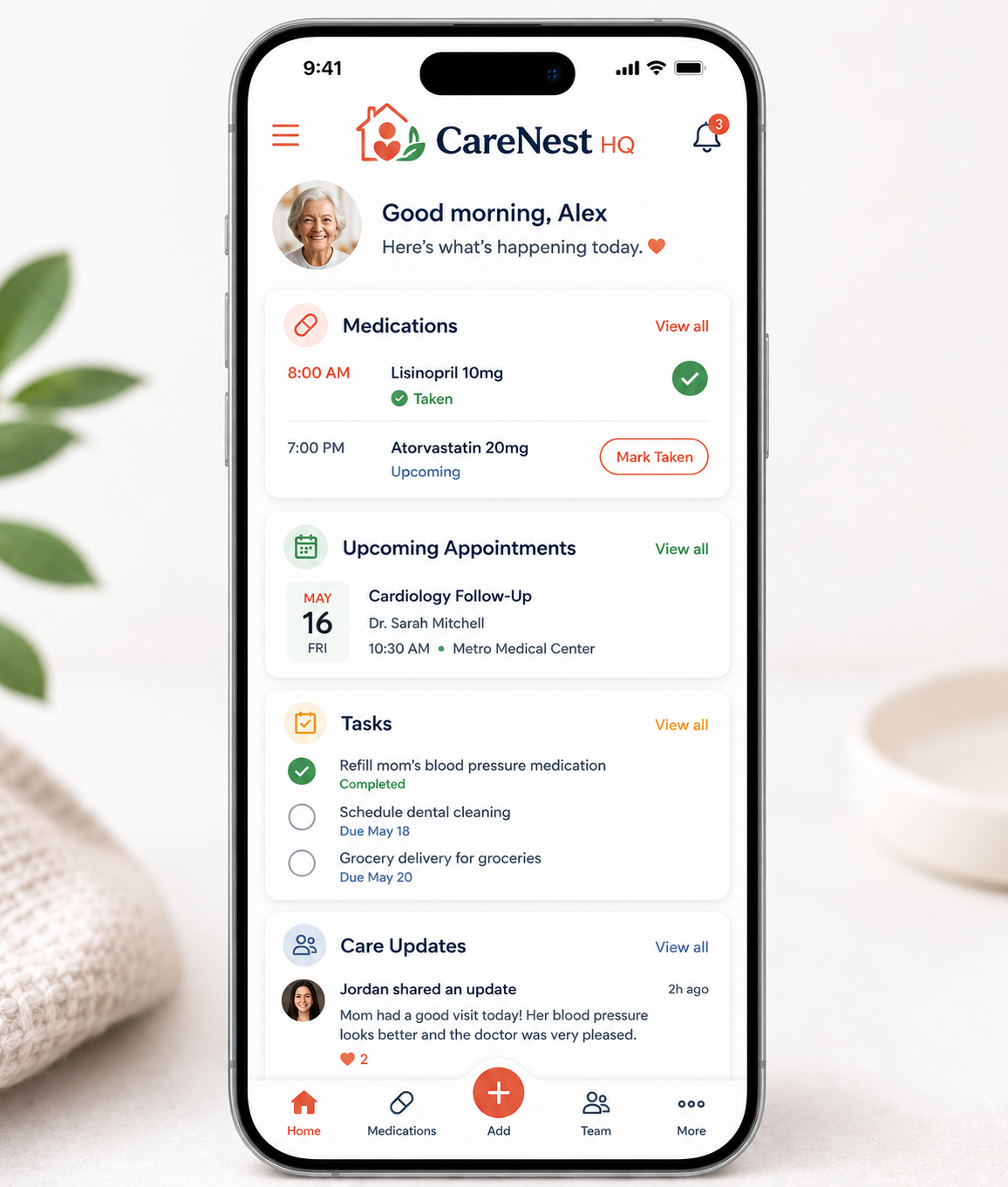
Hospital discharge creates tasks, medication changes, appointments, documents, and family updates all at once. CareNestHQ brings those moving parts into one shared care space so one person does not have to carry everything alone.

CareNestHQ shared care dashboard showing medications, appointments, tasks, and family updates after hospital discharge
Highest-risk window

What Your Family Needs to Do in the First 72 Hours After Discharge

The first 72 hours after hospital discharge carry the highest risk of complications. The window matters not just medically but organizationally: this is when the foundation of family care coordination is either established or left to chance.

Step 1

Get the written discharge plan before leaving the hospital

Verbal instructions are not sufficient. They fade within hours. Request a written discharge summary, medication list, and questions to ask before leaving the hospital answered in writing before you leave.

Step 2

Review the full medication list

Compare what your parent was taking before hospitalization with what they have been prescribed at discharge. Note every change. Discharge summaries often lack complete information. Discharge medications are missing 22% of the time, and pending test results are missing 75% of the time. If anything is unclear, ask the discharge nurse before leaving.

Step 3

Fill all prescriptions the same day

Assign one person to this task before leaving the hospital. Do not assume it will happen. Name the person and confirm they have what they need.

Step 4

Confirm the first follow-up appointment

Verify that an appointment has been scheduled with the primary care physician within seven days. If it has not been scheduled, schedule the follow-up appointment before leaving the hospital. Do not leave this as an open task.

Step 5

Confirm home health or physical therapy has a start date

A referral is not the same as a confirmed visit. Call the agency to confirm the first visit date and time before assuming services will arrive.

Step 6

Name who is staying with your parent in the first 24 to 48 hours

Do not leave this open. Name a specific person. The first 48 hours at home represent the highest-risk period. Your parent should not be alone.

Step 7

Send one shared update to every family member

Write it once. Send it to everyone. Cover what happened, what comes next, and who is handling what. This one act eliminates most repeat calls the primary caregiver will otherwise receive.

Step 8

Store the discharge summary somewhere every family member can access

Not in one person's email. Not in a text thread. Somewhere that every family member can find it quickly.

Clear ownership

Assigning Family Responsibilities After Hospital Discharge

What is a family responsibility map?

A family responsibility map is a written assignment of caregiving tasks to named family members. It covers every responsibility involved in post-discharge care and assigns each item to one specific person. It prevents both task duplication and the gaps that form when responsibilities are assumed rather than assigned.

The biggest coordination failure after a hospital discharge is not missing information. It is missing ownership. When no one is explicitly assigned to a task, the task either gets duplicated or it does not get done. Both outcomes are preventable with one explicit conversation before leaving the hospital, or as the first act of family recovery coordination after arriving home.

Use the table below as a starting point. Fill in a name for each responsibility. Every row should have a name. If a row is blank, it is an unmanaged risk.

Scroll sideways to view the full table.

Responsibility Who Owns It
Prescription pickup and refills  
Follow-up appointment scheduling  
Insurance coordination and authorizations  
Daily or weekly check-in visits  
Transportation to appointments  
Medication administration or monitoring  
Document organization and storage  
Coordinating home health or PT visits  
Family communication updates  
Grocery, errands, and household support  

Prescription pickup and refills

Who owns it:  

Follow-up appointment scheduling

Who owns it:  

Insurance coordination and authorizations

Who owns it:  

Daily or weekly check-in visits

Who owns it:  

Transportation to appointments

Who owns it:  

Medication administration or monitoring

Who owns it:  

Document organization and storage

Who owns it:  

Coordinating home health or PT visits

Who owns it:  

Family communication updates

Who owns it:  

Grocery, errands, and household support

Who owns it:  

Long-distance family members can take on most tasks that do not require physical presence. The next section covers that directly.

Remote support

How Long-Distance Family Members Can Help After Hospital Discharge

Living far away does not mean being unhelpful. It means the type of help looks different. Most long-distance family members want to contribute to sibling caregiving coordination but are not sure what they can realistically own from a distance. The answer is more than most realize, and in many cases, the help that matters most is taking over phone-and-email tasks so the person who is physically present can focus on care.

Task Why It Works Remotely
Insurance coordination and prior authorization calls Entirely phone and email-based
Scheduling specialist follow-up appointments Can be done by phone or online from anywhere
Researching home health agencies and options Research does not require physical presence
Managing and organizing documents digitally Upload, label, and organize using shared access
Sending family updates when the primary caregiver is overwhelmed Take over communication for a day or a week
Tracking medications and flagging schedule inconsistencies Visible in a shared system without being in the home
Ordering supplies, groceries, or equipment for delivery Handled entirely online
Managing financial paperwork and insurance correspondence Phone and email-based

Insurance coordination and prior authorization calls

Entirely phone and email-based

Scheduling specialist follow-up appointments

Can be done by phone or online from anywhere

Researching home health agencies and options

Research does not require physical presence

Managing and organizing documents digitally

Upload, label, and organize using shared access

Sending family updates when the primary caregiver is overwhelmed

Take over communication for a day or a week

Tracking medications and flagging schedule inconsistencies

Visible in a shared system without being in the home

Ordering supplies, groceries, or equipment for delivery

Handled entirely online

Managing financial paperwork and insurance correspondence

Phone and email-based

The primary caregiver's heaviest burden is often not the physical care. It is being the only person who knows what is happening. A long-distance family member who takes ownership of information, including the medication list, the appointment schedule, and the insurance status, and shares that back relieves a real and measurable part of that weight.

30-day framework

The CareNestHQ Recovery Coordination System™: A Four-Phase Approach to the First 30 Days

The shared structure families use after hospital discharge

Most families manage the weeks after hospital discharge without a shared structure. Each week becomes its own improvisation. Responsibilities drift. The primary caregiver carries more than their share because no one else has a clear view of what needs attention.

The CareNestHQ Recovery Coordination System™ gives families a four-phase approach to post-discharge coordination. It covers the medical, organizational, and shared caregiving responsibilities that determine whether recovery goes smoothly.

Week 1

Stabilize

Establish safety. Confirm medications, first follow-up, and home health.

Week 2

Organize

Build routine. Close coordination gaps and share the full calendar.

Week 3

Monitor

Track adherence. Watch for warning signs and caregiver support.

Week 4

Reassess

Evaluate the plan. Redistribute responsibilities and plan what's next.

Week Phase Primary Goal
Week 1 Stabilize Establish safety. Confirm medications, first follow-up, and home health. Assign responsibilities.
Week 2 Organize Build routine. Close coordination gaps. Organize documents and share the full calendar.
Week 3 Monitor Track adherence. Watch for warning signs. Check that the care plan is still working.
Week 4 Reassess Evaluate the current plan. Redistribute responsibilities if needed. Plan the next 30 days.
Week 1 · Stabilize

Establish safety. Confirm medications, first follow-up, and home health. Assign responsibilities.

Week 2 · Organize

Build routine. Close coordination gaps. Organize documents and share the full calendar.

Week 3 · Monitor

Track adherence. Watch for warning signs. Check that the care plan is still working.

Week 4 · Reassess

Evaluate the current plan. Redistribute responsibilities if needed. Plan the next 30 days.

Phase 1 · Week 1

Stabilize

Establish safety and make sure nothing critical is missed in the highest-risk window.

  • Medications filled, reviewed, and on schedule
  • First follow-up appointment completed
  • Home health or PT first visit completed
  • All family members updated with the same information
  • Responsibilities assigned to named people
  • Discharge summary stored and accessible

Phase 2 · Week 2

Organize

Build a sustainable care routine and close coordination gaps from Week 1.

  • Medication routine confirmed and consistent
  • Home health or PT schedule established
  • Specialist follow-ups scheduled
  • Second family update shared
  • Task ownership confirmed: no unassigned items remaining
  • 30-day appointment calendar shared

Phase 3 · Week 3

Monitor

Watch for warning signs and catch problems before they escalate.

  • Medication adherence tracked and confirmed
  • Follow-up appointments attended
  • Warning signs reviewed with family
  • Family check-in: is the care plan working?
  • Primary caregiver support assessed
  • New documents added as they arrive

Phase 4 · Week 4

Reassess

Evaluate the current care plan and decide what the next 30 days require.

  • 30-day follow-up scheduled or completed
  • Current care level sustainability evaluated
  • New concerns documented for physician discussion
  • Family update: what is working, what needs to change
  • Responsibilities redistributed if needed
  • Plan for next 30 days documented

Key Takeaways: The CareNestHQ Recovery Coordination System™

  • The first 30 days after hospital discharge are the highest-risk window for readmission and adverse events
  • The four phases (Stabilize, Organize, Monitor, Reassess) give families a shared structure week by week
  • Each phase covers medical, coordination, and organizational priorities
  • The System is designed to be used by the whole family, not carried by one person
  • The framework adapts to other major caregiving events: dementia diagnosis, recovery after a fall, post-surgery care

Includes the full Recovery Coordination System™ and family responsibility template.

Your family does not need another text thread.

CareNestHQ gives everyone one shared place to track medications, appointments, tasks, documents, and updates after discharge.

Escalation guidance

When to Call the Doctor, When to Go to Urgent Care, and When to Call 911

One of the most common fears after hospital discharge is not knowing what to do if something goes wrong at home. Discharge instructions always include specific warning signs and guidance on who to contact. This section does not provide medical advice. It explains how to use the guidance your family already received.

Read the discharge instructions before a problem occurs, not during one.

The escalation guidance in your parent's discharge paperwork is specific to their condition, medications, and care situation. That document is your reference. The general framework below is a starting point only.

Situation Suggested First Step
A question about medication timing or recovery process Call the primary care physician or the hospital's discharge nurse line
A symptom listed as a warning sign in your discharge instructions Follow the escalation guidance written in those instructions
A new symptom that is concerning but does not feel like an emergency Call the primary care physician during business hours; call the nurse line after hours
Uncertainty about severity, not sure if it is serious Call the nurse line before going to urgent care or the ER
Obvious emergency: chest pain, stroke symptoms, difficulty breathing, unresponsiveness Call 911 immediately
Question

Medication timing or recovery process

Call the primary care physician or the hospital's discharge nurse line.

Warning sign

Symptom listed in discharge instructions

Follow the escalation guidance written in those instructions.

Concerning symptom

New symptom that does not feel like an emergency

Call the primary care physician during business hours; call the nurse line after hours.

Uncertain severity

Not sure if it is serious

Call the nurse line before going to urgent care or the ER.

Emergency

Chest pain, stroke symptoms, difficulty breathing, unresponsiveness

Call 911 immediately.

Most hospitals and health systems have 24-hour nurse lines. If your parent's discharge paperwork includes a phone number to call with questions, save it in your phone before you need it. Store the discharge summary and warning signs list somewhere every family member can access from any device.

Learn from others

The Most Common Mistakes Families Make After a Hospital Discharge

These are not mistakes born from carelessness. They are mistakes born from a system that hands families complex responsibilities with almost no coordination support.

Scroll sideways to view the full table.

Mistake What Happens What to Do Instead
Assuming the hospital coordinated home health services Home health never shows up for the first visit Confirm every service before leaving. A referral is not a scheduled visit
Not reviewing the medication list at discharge Dangerous dosing error or missed medication Do a side-by-side comparison of before and after medications before leaving
Relying on verbal instructions Instructions forgotten within hours Get everything in writing: all medication, all appointments, all warning signs
Not confirming the 7-day follow-up appointment Condition worsens without medical oversight Schedule the follow-up before leaving the hospital
Leaving siblings out of the loop Duplicate calls, conflicting information, family conflict Send one shared update to everyone with the same information
Not assigning task ownership Responsibilities fall through or get duplicated Assign a named person to every item before leaving the hospital
Assuming your parent can manage alone on day one Readmission within 72 hours Have someone physically present for at least the first 48 hours

Assuming the hospital coordinated home health services

What happens Home health never shows up for the first visit

What to do instead Confirm every service before leaving. A referral is not a scheduled visit

Not reviewing the medication list at discharge

What happens Dangerous dosing error or missed medication

What to do instead Do a side-by-side comparison of before and after medications before leaving

Relying on verbal instructions

What happens Instructions forgotten within hours

What to do instead Get everything in writing: all medication, all appointments, all warning signs

Not confirming the 7-day follow-up appointment

What happens Condition worsens without medical oversight

What to do instead Schedule the follow-up before leaving the hospital

Leaving siblings out of the loop

What happens Duplicate calls, conflicting information, family conflict

What to do instead Send one shared update to everyone with the same information

Not assigning task ownership

What happens Responsibilities fall through or get duplicated

What to do instead Assign a named person to every item before leaving the hospital

Assuming your parent can manage alone on day one

What happens Readmission within 72 hours

What to do instead Have someone physically present for at least the first 48 hours

Built for discharge coordination

How CareNestHQ Helps Families Coordinate Care After Hospital Discharge

Hospital discharge creates more coordination work than almost any other single event in family caregiving. Medications change. Appointments multiply. Siblings who were not involved before are suddenly asking questions. The primary caregiver becomes the manager, the communicator, the scheduler, and the on-call resource for everyone else.

According to AARP and the National Alliance for Caregiving, 26% of family caregivers report difficulty coordinating care, a number that rises sharply during and immediately after a hospital discharge. CareNestHQ is designed around exactly this situation.

Keep every family member informed

One Care Update reaches every family member. Siblings see the same information at the same time. The primary caregiver writes it once.

Track every appointment in one shared calendar

Follow-up appointments, home health visits, physical therapy, specialist check-ins, in one view every family member can access.

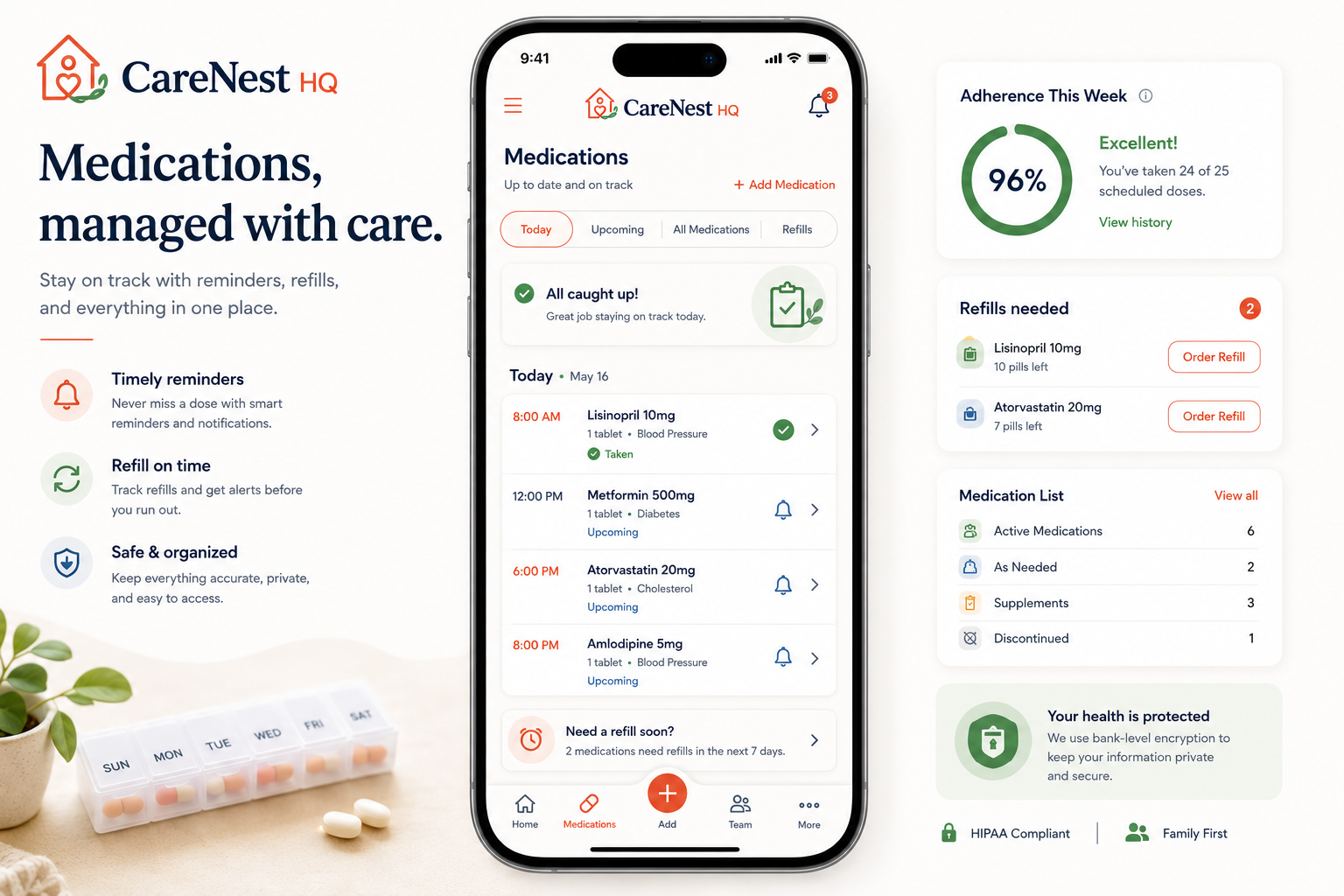
Manage medications with confidence

Track what was prescribed at discharge, when each medication should be taken, and whether it was administered, all in one shared place your whole family can see.

Store every document where your family can find it

Discharge summary, prescriptions, specialist referrals, insurance documents, uploaded once, accessible to everyone.

Assign every task to a named person

Each caregiving responsibility has an owner and a due date. Nothing is assumed. Nothing falls through.

See what needs attention today

The Home Dashboard gives the primary caregiver a daily view of what needs attention, without checking five different places.

See How CareNestHQ Works
Realistic example

A Realistic Example: How One Family Found a Better Way to Coordinate

Family supporting an aging parent during care coordination at home

The following is an example scenario.

Margaret, 74, was discharged after a cardiac procedure. Her daughter Linda, 47, managed the hospital stay. Her brother David, 52, lives in Denver. Her sister Rachel, 44, lives in Boston.

The coordination problem

David called Linda three times the day of discharge. Rachel called twice. Each call started with "so what exactly happened." Linda repeated the same update four times while trying to organize medications, schedule a follow-up, and get Margaret settled at home.

Nobody had been assigned to pick up the prescriptions. It turned out nobody had done it. Linda drove back to the pharmacy at 9pm.

The first week was functional but exhausting. Linda was the single point of contact for everything. David and Rachel felt helpful when they called. Linda felt more burdened after every call.

What changed

Linda created a CareNestHQ account and invited David and Rachel. She uploaded the discharge summary, set up the medications, and posted one Care Update covering what happened and what came next. She assigned tasks: David took insurance coordination by phone, Rachel took follow-up scheduling, Linda managed the day-to-day care.

The realistic outcome

The calls did not stop. But they changed. Instead of "what happened," the calls became "I scheduled the cardiology appointment, it is on the calendar." Instead of repeated updates, there was one shared record that David and Rachel could check without calling Linda.

Linda was still the primary caregiver and the hardest-working person in the family's care arrangement. But she was no longer the only person who knew what was going on. That was the difference.


Coordination methods

How Families Typically Try to Coordinate After Discharge

Scroll sideways to compare coordination methods.

Feature Text Messages Shared Spreadsheet Paper Binder CareNestHQ
Shared family visibility Partial Limited No Yes
Medication tracking No Manual No Yes
Task assignment with ownership No Manual No Yes
Document storage No No Paper only Yes
Appointment coordination No Manual Paper Yes
Emergency document access No No No Yes
Long-distance sibling access Partial Limited No Yes
One shared update for all family No No No Yes

Shared family visibility

Text Messages
Partial
Shared Spreadsheet
Limited
Paper Binder
No
CareNestHQ
Yes

Medication tracking

Text Messages
No
Shared Spreadsheet
Manual
Paper Binder
No
CareNestHQ
Yes

Task assignment with ownership

Text Messages
No
Shared Spreadsheet
Manual
Paper Binder
No
CareNestHQ
Yes

Document storage

Text Messages
No
Shared Spreadsheet
No
Paper Binder
Paper only
CareNestHQ
Yes

Appointment coordination

Text Messages
No
Shared Spreadsheet
Manual
Paper Binder
Paper
CareNestHQ
Yes

Emergency document access

Text Messages
No
Shared Spreadsheet
No
Paper Binder
No
CareNestHQ
Yes

Long-distance sibling access

Text Messages
Partial
Shared Spreadsheet
Limited
Paper Binder
No
CareNestHQ
Yes

One shared update for all family

Text Messages
No
Shared Spreadsheet
No
Paper Binder
No
CareNestHQ
Yes
Printable resource

Hospital Discharge Checklist for Family Caregivers

Use this as your family's discharge command center

Print it, save it, or use it as the starting point for assigning responsibilities inside CareNestHQ.

Use this checklist as a printable companion to this guide, or read the full hospital discharge checklist with the 5-Phase Hospital Discharge Checklist framework, warning signs, and downloadable PDF. Check off each item as your family completes it.

Before Leaving the Hospital

  • Written discharge plan received
  • Medication list reviewed with nurse, every change noted
  • New prescriptions assigned to one person for same-day pickup
  • First follow-up appointment confirmed and scheduled
  • Home health or PT confirmed with a start date, not just a referral
  • Insurance authorizations confirmed for all ordered services
  • Warning signs and escalation guidance reviewed with care team
  • Discharge nurse line number saved to phone
  • Emergency contacts updated

Discharge Day

  • Prescriptions filled before arriving home
  • Home prepared for arrival: clear path, necessary equipment in place
  • One shared family update sent with the same information to everyone
  • Discharge summary stored where all family members can access it

First 48 Hours at Home

  • Someone physically present with your parent
  • Medications administered on correct schedule
  • First home health or PT visit confirmed
  • Follow-up appointment on shared family calendar
  • Family responsibilities assigned to named people

First 30 Days

  • CareNestHQ Recovery Coordination System™ in use
  • Weekly family updates sent
  • Medication adherence tracked
  • All follow-up appointments attended
  • Documents organized and accessible to all family members
  • Care plan reassessed at Day 30

Quick Definitions

What is hospital discharge care planning?

The process of organizing the medical instructions, medication changes, follow-up appointments, and family responsibilities that take effect when a patient leaves the hospital.

What is family care coordination after hospital discharge?

The process by which family members organize and manage shared caregiving responsibilities, including medications, appointments, task ownership, and communication, after a patient returns home from the hospital.

What is the CareNestHQ Recovery Coordination System™?

A four-phase framework for family caregiving coordination after a major care event. The phases (Stabilize, Organize, Monitor, Reassess) give families a shared structure for managing the first 30 days after hospital discharge.

What is a family responsibility map?

A written assignment of specific caregiving tasks to named family members. It is used to prevent both task duplication and the gaps that form when responsibilities are assumed rather than explicitly assigned.

Common questions

Frequently Asked Questions

What should I do the day my parent is discharged from the hospital?

Get the written discharge plan before leaving, review the full medication list with the nurse, fill all new prescriptions the same day, confirm the first follow-up appointment is scheduled, and send one shared update to every family member. Assign someone to stay with your parent for the first 24 to 48 hours. Do not rely on verbal instructions. Request everything in writing.

What is hospital discharge care planning?

Hospital discharge care planning is the process of organizing the medical instructions, medication changes, follow-up appointments, and family responsibilities that come into effect when a patient leaves the hospital. It includes both the clinical discharge plan provided by the hospital and the family coordination work required to carry it out.

What is a hospital discharge plan?

A hospital discharge plan is a written document provided by the hospital at the time of discharge. It outlines the patient's destination after leaving, all current medications with dosages and schedules, required follow-up appointments, any home health or therapy services ordered, and warning signs that warrant medical attention.

How do I assign family responsibilities after a hospital discharge?

Use a family responsibility table to assign each task to a named person before leaving the hospital or in the first family conversation after discharge. Cover prescription pickup, follow-up scheduling, insurance coordination, daily check-ins, transportation, medication monitoring, and document organization. Every task should have one owner. Unassigned tasks are unmanaged risks.

What is the CareNestHQ Recovery Coordination System™?

The CareNestHQ Recovery Coordination System™ is a four-phase framework for family coordination after a major caregiving event such as hospital discharge. The four phases are Stabilize (Week 1), Organize (Week 2), Monitor (Week 3), and Reassess (Week 4). Each phase covers the medical, coordination, and organizational priorities that families need to address to support a safe recovery.

What are the most dangerous days after a hospital discharge?

The first 72 hours at home carry the highest risk. After that, the first 30 days represent the window during which most adverse events occur. The majority of these events are caused by medication errors, missed follow-up appointments, and coordination failures rather than purely medical complications.

How do I manage medication changes after a hospital discharge?

Before leaving the hospital, compare the new medication list against what your parent was taking before admission. Note every change: new medications, discontinued medications, and dosage adjustments. Fill all prescriptions the same day. Assign one family member to track medication administration and flag any inconsistencies. Store the medication list somewhere every family member can access.

How do I keep my siblings informed after a parent's hospital discharge?

Send one shared update to all family members with the same information as soon as possible after discharge. Avoid phone tree communication where each person gets a different version of events. Use a shared platform so every family member can see the same information without requiring the primary caregiver to repeat themselves.

What is a family responsibility map for caregiving?

A family responsibility map is a written assignment of caregiving tasks to named family members. It covers every responsibility involved in post-discharge care, from prescription pickup to insurance coordination to daily check-ins, and assigns each item to a specific person with clear ownership. It prevents both task duplication and gaps caused by assumed responsibility.

How do long-distance family members help after a parent's hospital discharge?

Long-distance family members can take ownership of tasks that do not require physical presence: insurance coordination, follow-up appointment scheduling, document organization, researching home health agencies, ordering supplies and groceries online, and sending family updates. In many cases, taking over one or two of these tasks removes a significant burden from the primary caregiver who is managing in-person care.

When should I call the doctor vs. go to the emergency room after a hospital discharge?

Your discharge instructions include specific guidance for your parent's situation. Follow those instructions as your primary reference. As a general framework: call the physician or nurse line for questions about medications, recovery, or new symptoms that are not emergencies. Call the nurse line if you are uncertain about severity before going to urgent care. Call 911 for obvious emergencies including chest pain, stroke symptoms, difficulty breathing, or unresponsiveness.

What documents should I keep from the hospital discharge?

Keep the full discharge summary, the complete medication list with all changes noted, specialist referral paperwork, insurance authorization documents, home health or PT orders, and the list of warning signs and escalation contacts. Store these where every family member can access them, not in one person's email or text history.

How do I prevent hospital readmission after a parent comes home?

Fill all prescriptions the same day, complete the first follow-up appointment within seven days, have someone physically present for the first 48 hours, confirm home health services have a scheduled start date, and track medication adherence. Most readmissions are preventable and stem from coordination failures rather than clinical deterioration.

What should be in a 30-day care plan after hospital discharge?

A 30-day care plan should cover medication management and adherence tracking, all scheduled follow-up appointments, home health and therapy visit schedule, family responsibility assignments, a communication plan for keeping all family members informed, document organization, and a Day 30 reassessment of whether the current care level is sustainable.

What are the most common mistakes families make after a hospital discharge?

The most common mistakes are: not confirming home health services before leaving the hospital, failing to review the medication list at discharge, relying on verbal instructions, not scheduling the 7-day follow-up before leaving, leaving siblings uninformed, not assigning explicit task ownership, and assuming the patient can manage alone on day one. Each of these is preventable with preparation and coordination.

Evidence-based guidance

Sources and Resources

The guidance on this page draws from established caregiving research and the following authoritative organizations.

  • Agency for Healthcare Research and Quality (AHRQ) ahrq.gov Be Prepared to Go Home Checklist and post-discharge adverse event research
  • PSNet / AHRQ Patient Safety Network psnet.ahrq.gov Readmissions and Adverse Events After Discharge
  • Centers for Medicare and Medicaid Services (CMS) medicare.gov Your Discharge Planning Checklist and patient rights information
  • StatPearls / National Library of Medicine ncbi.nlm.nih.gov Reducing Hospital Readmissions
  • NCQA ncqa.org Transitions of Care quality measures and discharge summary data
  • Family Caregiver Alliance caregiver.org Hospital Discharge Planning: A Guide for Families and Caregivers
  • AARP and National Alliance for Caregiving aarp.org Caregiving in the US 2025 and caregiving coordination research
  • National Library of Medicine (MedlinePlus) medlineplus.gov Leaving the Hospital: Your Discharge Plan
  • National Institute on Aging nia.nih.gov Caregiving and care transitions resources

CareNestHQ does not provide medical advice. The guidance on this page is intended to help families coordinate care responsibilities. Always follow the instructions provided by your parent's medical team and contact a qualified healthcare provider with clinical questions. For how we approach privacy and family care space access, see our privacy overview.

Illustrative scenario

A Common Family Experience After Hospital Discharge

Based on situations many families face when coordinating care for a parent after hospitalization.

When our mom came home from the hospital, coordinating her recovery became a full-time job.

My three sisters and I were trying to manage appointments, medications, transportation, and daily updates through text messages. Important details were getting lost, responsibilities weren't always clear, and everyone kept asking the same questions.

What changed was having one place where everyone could see the care plan, upcoming appointments, medications, and family updates.

Instead of spending our time tracking down information, we spent our time helping our mom recover.

During one of the most stressful periods our family had faced, having a shared system brought clarity and reduced confusion.

This example represents a common caregiving scenario and is provided for illustrative purposes.

Your Parent Is Home. Now Your Family Needs a System.

Hospital discharge is the moment most families realize that coordination cannot run through one person's text messages and memory. CareNestHQ gives your family one shared place to organize care, assign responsibilities, and stay informed, starting today.

Download the Hospital Discharge Planner