Start Your Care Space
Hospital Discharge

Medication Changes After Hospitalization: A Family Caregiver Guide

A hospital stay rarely ends with the same pill bottles your parent brought in. Teams add antibiotics, stop blood thinners, or change doses while treating the admission. This guide walks your family through medication reconciliation: compare before-and-after lists, assign a medication lead, and catch dangerous overlaps before the first dose at home.

Family caregivers reviewing medication lists together after hospital discharge to prevent dosing errors at home.
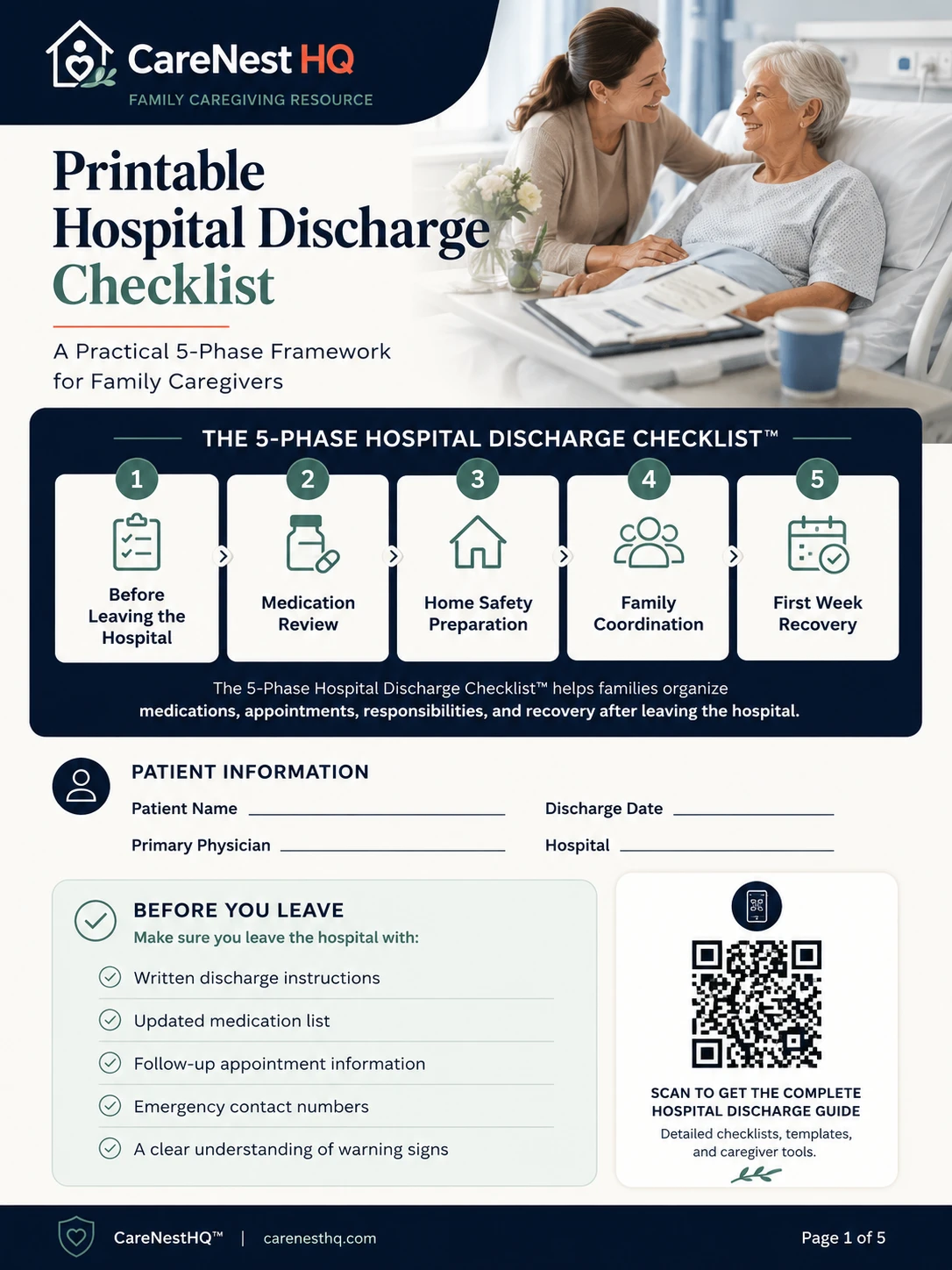
CareNestHQ Printable Hospital Discharge Checklist PDF cover
FREE PDF

Printable Hospital Discharge Checklist

Take this printable checklist to the hospital, share it with family members, and keep medications, appointments, discharge instructions, and caregiver responsibilities organized during the first week home.

  • Bring to the hospital
  • Share with siblings
  • Track medications
  • Record appointments
  • Keep emergency contacts together
  • Instant download
  • No email required
  • Print at the bedside
Signature tool

Medication Reconciliation Worksheet

Use this table the day your parent comes home. Compare what they took before admission with the discharge list. Record who owns each action so no dose is missed or doubled.

Scroll sideways on mobile to view all columns.

Medication Before Hospital At Discharge Change Type Family Action Owner
Example: Lisinopril 10 mg daily 20 mg daily Dose changed Discard old bottle; use new prescription only Medication lead
Example: Aspirin 81 mg daily Stopped Stopped Remove from pill organizer Daily administrator
Example: New antibiotic Not taken at home 500 mg twice daily × 7 days Added Pharmacy pickup today Pickup owner
(add each drug) Added / Stopped / Dose changed / Continue

Lisinopril: dose changed

Before
10 mg daily
At discharge
20 mg daily
Action
Discard old bottle; use new prescription only

Aspirin: stopped

Before
81 mg daily
At discharge
Stopped
Action
Remove from pill organizer

New antibiotic: added

Before
Not taken at home
At discharge
500 mg twice daily × 7 days
Action
Pharmacy pickup today

Why Medication Changes Matter After Hospitalization

Medication errors send more older adults back to the hospital than almost any other discharge mistake. During admission, hospital staff manage one list while home bottles may still sit in the cabinet unchanged.

Discharge papers often arrive minutes before you leave. Without a line-by-line comparison, family caregivers can double a dose, restart a drug that was stopped, or miss a new prescription entirely.

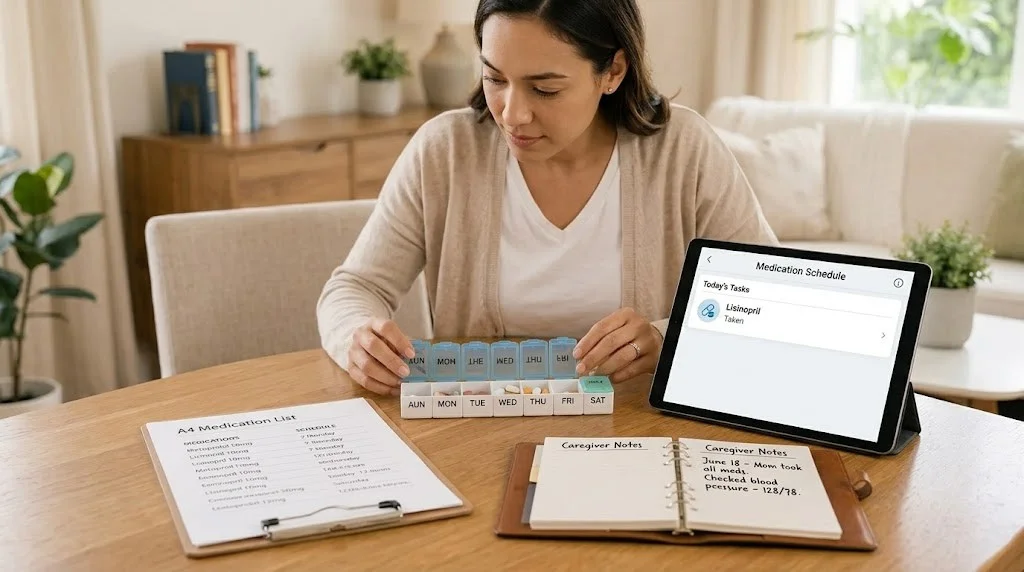
Caregiver using a tablet with a pill organizer to manage medications after hospital discharge
A shared tablet and pill organizer help families track medication changes in one place.
What to expect

Four Types of Medication Changes

Every discharge list usually includes some combination of these changes. Knowing the category helps your family take the right action.

Change type What it means Family action
Added New prescription for recovery or prevention Pick up today; add to master list; confirm short-term vs long-term
Stopped Held during stay or discontinued at discharge Remove from pill organizer; do not continue home supply
Dose changed Same drug, different strength or frequency Replace home bottle; never use old dose
Supplements / OTC Vitamins, aspirin, herbals not on discharge list Ask pharmacist what to continue or avoid

Added

What it means
New prescription for recovery or prevention
Family action
Pick up today; add to master list; confirm short-term vs long-term

Stopped

What it means
Held during stay or discontinued at discharge
Family action
Remove from pill organizer; do not continue home supply

Dose changed

What it means
Same drug, different strength or frequency
Family action
Replace home bottle; never use old dose

Supplements / OTC

What it means
Vitamins, aspirin, herbals not on discharge list
Family action
Ask pharmacist what to continue or avoid

Seven Steps to Compare Medication Lists

For questions to ask at the hospital, see Questions to Ask Before Leaving the Hospital.

  1. Gather the home list: bottles, organizers, pharmacy printouts from before admission.
  2. Get the discharge list in writing: not verbal instructions alone.
  3. Compare line by line: generic and brand names, dose, frequency, route.
  4. Flag duplicates: two drugs in the same class can be dangerous.
  5. Photograph and share: send to every caregiver the same day.
  6. Assign a medication lead: one owner for the first two weeks home.
  7. Confirm with a pharmacist: community pharmacist reviews the full list.

If a sibling lives out of state, assign pharmacy calls and list updates using the remote caregiver guide for supporting aging parents from afar.

Family caregivers reviewing medication lists together at home after hospital discharge
Reviewing medications together reduces dosing errors when multiple family members help with care.

Common Medication Errors After Discharge

  • Continuing a medication the hospital stopped
  • Missing a new prescription because no one picked it up the same day
  • Using an old dose from a home bottle after the hospital changed strength
  • Two caregivers giving the same dose without coordinating
  • Forgetting to update the pill organizer after the list changes

Use the Hospital Discharge Checklist for a printable medication review phase, organizing medical information for a shared family medication list, and the Hospital Discharge Care Planning guide for full recovery coordination.

One shared medication list for the whole family.

CareNestHQ™ helps families track medication changes, appointments, and discharge documents in one shared care space after hospitalization.

Built for family caregivers

How CareNestHQ™ Helps Families After Discharge

Hospital discharge creates an immediate coordination problem: medications change, appointments multiply, and siblings who were not involved before start asking questions. The family member closest to the situation becomes the single point of contact for everything. Remote siblings can own pharmacy calls and list accuracy from afar. See Long Distance Caregiving After Hospital Discharge for the remote caregiver playbook.

CareNestHQ™ is designed around exactly this situation. One shared care space for your whole family, so medications, appointments, tasks, and discharge documents are visible to everyone, not just the person who was in the hospital room.

Store discharge documents where everyone can find them

Upload the discharge summary, medication list, and follow-up instructions once. Every family member can access them from any device without calling the primary caregiver.

Track medication changes from day one

Log every medication added, changed, or discontinued at discharge. Every family member sees the same list. No one is working from a different version.

Assign tasks to named people

Prescription pickup, follow-up scheduling, insurance coordination, daily check-ins. Each task has one owner and a due date. Nothing is assumed.

Send one update to everyone

Write the discharge summary once. Send it to every family member at the same time. Eliminate the repeat calls and conflicting versions.


Common questions

Frequently Asked Questions

Why do hospitals change so many medications at discharge?

Hospitals treat acute problems during the stay. Some home medications are paused for procedures. New drugs may be added for recovery. The discharge list reflects what the care team wants your parent taking at home.

Should we use the hospital list or our home bottles?

Use the written discharge list as the source of truth. Compare every home bottle to that list before giving any dose. When in doubt, call the pharmacist or discharge nurse line.

How soon should we fill new prescriptions after discharge?

Fill time-sensitive prescriptions the same day if possible. Assign one person to pharmacy pickup and confirm each new drug is labeled clearly for your parent.

What if the discharge list conflicts with our primary care doctor's instructions?

Call the primary care office the same day. Ask which list to follow until a follow-up appointment. Document the answer and share it with all caregivers.

Evidence-based guidance

Sources and Resources

The guidance on this page draws from established caregiving research and the following authoritative organizations.

  • Centers for Medicare and Medicaid Services (CMS) medicare.gov Your Discharge Planning Checklist and patient rights information
  • Agency for Healthcare Research and Quality (AHRQ) ahrq.gov Be Prepared to Go Home Checklist
  • National Library of Medicine (MedlinePlus) medlineplus.gov Leaving the Hospital: Your Discharge Plan
  • National Institute on Aging nia.nih.gov Caregiving and care transitions resources
  • Family Caregiver Alliance caregiver.org Hospital Discharge Planning: A Guide for Families and Caregivers

CareNestHQ™ does not provide medical advice. This guide helps families coordinate discharge responsibilities. Always follow instructions from your parent's medical team and contact a qualified healthcare provider with clinical questions. For how we approach privacy and family care space access, see our privacy overview and medical disclaimer.

Full library

Explore More Caregiving Resources

Browse the full library of guides, checklists, and recovery planning tools for family caregivers.

Next step

Your family deserves one source of truth for every medication change.

Discharge lists change fast. Scattered texts and outdated pill organizers create risk. CareNestHQ™ keeps added, stopped, and changed prescriptions visible to every caregiver, so no one works from a different version.