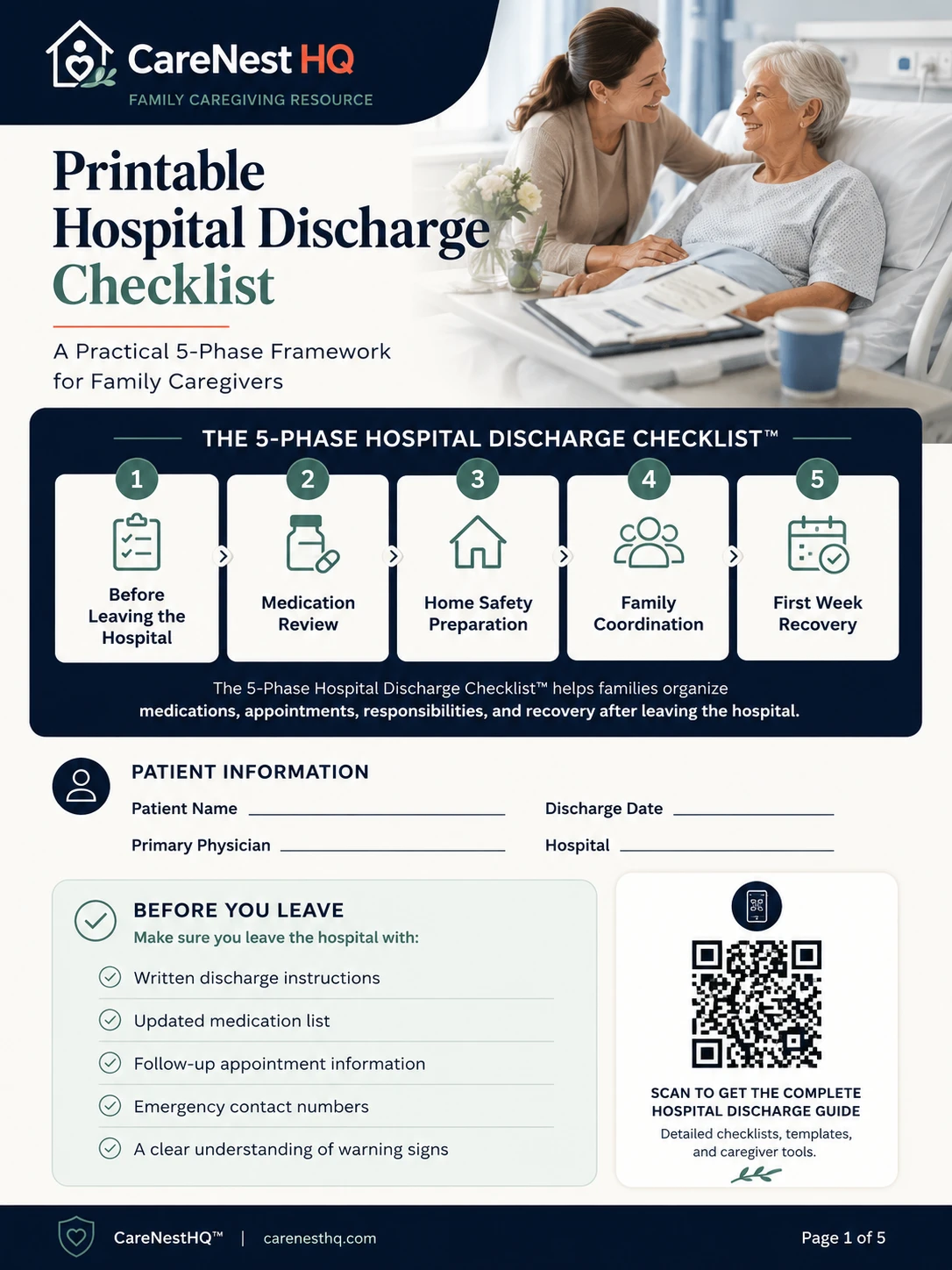
Use this checklist to prepare before your parent leaves the hospital and to coordinate the first week of recovery at home. It covers the tasks hospitals expect families to manage but rarely assign to a specific person.
Discharge day moves fast. Having a plan before you leave makes the first week at home significantly safer.
Hospital discharge is one of the most coordination-intensive moments in family caregiving. Your parent receives instructions. Your family receives responsibility. And most of the work that determines whether recovery goes smoothly happens after the hospital doors close.
This checklist is organized around The 5-Phase Hospital Discharge Checklist™, a framework designed for family caregivers who need to act quickly without letting critical tasks fall through. For the full coordination guide including the 30-day Recovery Coordination System™, see our Hospital Discharge Care Planning resource.
Work through each phase in order. Check items off as you complete them. Assign a named owner to every task that requires one. Most post-discharge problems are not medical failures. They are coordination failures, and coordination is something your family can prepare for before discharge day arrives.
FREE PDF
Printable Hospital Discharge Checklist
Take this printable checklist to the hospital, share it with family members, and keep medications, appointments, discharge instructions, and caregiver responsibilities organized during the first week home.
A hospital discharge checklist is a structured list of tasks and confirmations that family caregivers use before, during, and after a parent leaves the hospital. It goes beyond the clinical discharge summary by addressing the coordination work: who fills prescriptions, who schedules follow-up appointments, who stays with your parent in the first 48 hours, and how every family member receives the same information.
Most hospitals provide discharge instructions written for clinicians. A family discharge checklist translates those instructions into owned tasks with deadlines, so nothing depends on memory or a single person's text message thread.
Quick answer: A hospital discharge checklist for family caregivers should cover five areas: medications, follow-up appointments, home safety, family responsibilities, and first-week monitoring. The most common causes of hospital readmission are medication errors, missed appointments, and coordination failures, not medical complications.
The 5-Phase Hospital Discharge Checklist™ is CareNestHQ™'s structured framework for family caregivers managing a parent's transition from hospital to home care.
Use the printable PDF version if you want to check items off while planning a discharge.
Phase 1: Before Leaving the Hospital
The highest-risk coordination failures start here. Discharge day moves quickly. Use this phase to confirm that your family has everything in writing and that every critical task has an owner before you leave the building.
Understand the Discharge Plan
Written discharge plan received (not verbal instructions only)
Discharge destination confirmed (home, rehab, or other)
Activity restrictions and care limitations reviewed with the nurse
Warning signs and escalation guidance reviewed with care team
Discharge nurse line number saved to phone
Medications
Full medication list reviewed with nurse, every change noted
New prescriptions identified and assigned to one person for same-day pickup
Over-the-counter medications and supplements compared to pre-admission list
Pharmacy contact confirmed and pickup plan in place
First follow-up with primary care physician confirmed within seven days
Specialist follow-ups scheduled or referral process confirmed
Home health or physical therapy start date confirmed, not just a referral
Insurance authorizations confirmed for all ordered services
Documents to Collect Before Leaving
Discharge summary with diagnosis and treatment summary
Complete medication list with dosages and schedules
Home health, PT, or equipment orders in writing
Test results and pending lab work noted
Insurance and authorization paperwork collected
Equipment and Supplies
Durable medical equipment ordered and delivery confirmed
Walker, cane, or wheelchair ready before arrival home
Prescription medical supplies identified and ordered
Emergency contacts updated on file at hospital and at home
Phase 2: Medication Review and Reconciliation
Medication errors are the most common preventable complication after hospital discharge. This phase ensures your family understands every change before the first dose at home.
Compare the discharge medication list with what your parent was taking before admission. Do this before the first dose at home.
At Home, Before the First Dose
All new prescriptions filled before first scheduled dose
Discontinued medications removed from pill organizers and storage
Dosage changes confirmed against written discharge list
One family member assigned as medication owner for the first week
Medication schedule posted where caregivers can see it
If Something Does Not Match
Call the discharge nurse line before giving any unclear medication
Do not restart pre-hospital medications without physician confirmation
Document any discrepancy in writing for the follow-up appointment
Pharmacist consulted if pill appearance or instructions differ from discharge list
Sharing Medication Information with the Family
Updated medication list shared with every family caregiver
Changes from pre-admission medications clearly marked for all readers
Pharmacy phone number and refill plan accessible to backup caregivers
Medication list stored somewhere every family member can access
Prepare the home before your parent arrives. Falls and environmental hazards are common in the first days after discharge, especially when mobility, balance, or cognition has changed during the hospital stay.
A clear path, good lighting, and accessible essentials reduce fall risk in the first days home.
Bedroom
Clear path from door to bed with no cords or clutter
Night light installed between bed and bathroom
Phone, glasses, and water within reach of bed
Bed height safe for sitting and standing
Bathroom
Grab bars checked or installed in shower and near toilet
Non-slip mat placed in shower or tub
Toilet seat riser in place if ordered
Towels and toiletries within easy reach
General Home Safety
Loose rugs removed or secured
Stairs and walkways well lit
Medications stored safely away from heat and moisture
Walker, cane, or wheelchair placed where needed on arrival
Emergency Readiness
Emergency contacts posted visibly near phone
Discharge warning signs list posted for all caregivers
Phone charged and accessible at all times
911 address verified if using a mobile phone only
Phase 4: Family Coordination
Discharge instructions exist in abundance. Responsibility rarely does. This phase assigns every task to a named person and creates one shared source of truth for the whole family.
Explicit assignments prevent both duplicated effort and tasks that fall through entirely.
Assign Responsibilities
Family meeting held to assign tasks before or immediately after discharge
Every critical task has one named owner
Backup person identified for each primary responsibility
Primary caregiver support plan discussed openly
Family Responsibility Table
Fill in a name for each row. If a row is blank, it is an unmanaged risk.
Scroll sideways to view the full table.
Responsibility
Assigned
Backup
Phone
Prescription pickup and refills
Follow-up appointment scheduling
Daily check-in visits
Medication monitoring
Insurance coordination
Family communication updates
Prescription pickup and refills
Assigned
-
Backup
-
Phone
-
Follow-up appointment scheduling
Assigned
-
Backup
-
Phone
-
Daily check-in visits
Assigned
-
Backup
-
Phone
-
Medication monitoring
Assigned
-
Backup
-
Phone
-
Insurance coordination
Assigned
-
Backup
-
Phone
-
Family communication updates
Assigned
-
Backup
-
Phone
-
Create a Shared Information System
Discharge summary stored where every family member can access it
One shared family calendar for appointments and home health visits
One shared update sent to all family members with the same information
Document folder created for test results, authorizations, and referrals
For Families Coordinating from Different Locations
Primary caregiver given explicit permission to delegate
Follow-up appointment ownership assigned even if sibling is out of town
Scheduling follow-ups before they slip is one of the highest-impact tasks a remote sibling can own. See Follow-Up Appointment Planning for a dedicated guide.
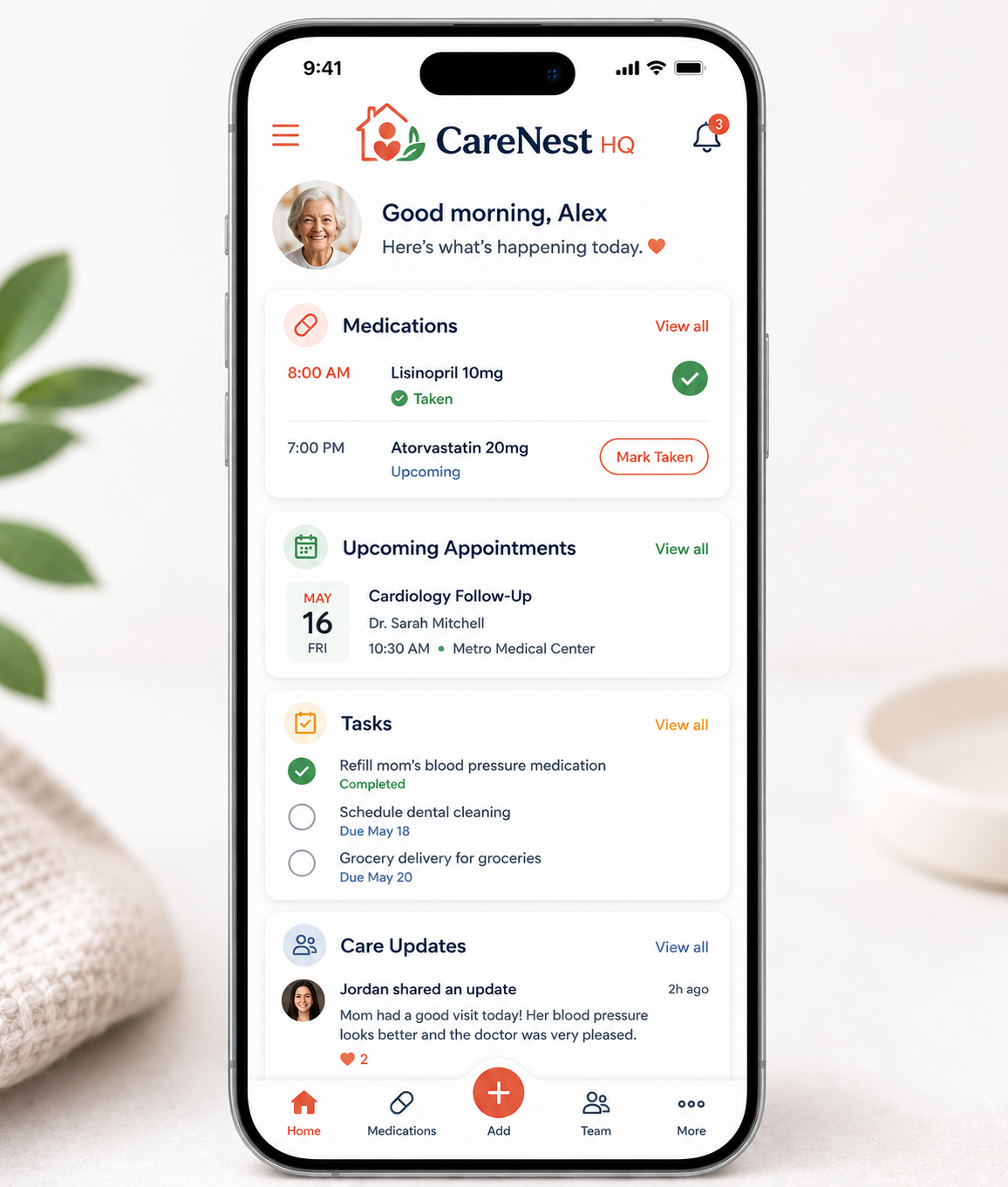
When medications, appointments, documents, and family updates live in different places, the primary caregiver becomes the human switchboard. CareNestHQ™ brings those moving parts into one shared care space so coordination does not depend on one person's memory or inbox.
The first week at home sets the pattern for the rest of recovery. Daily monitoring, clear escalation guidance, and caregiver support prevent small problems from becoming readmissions.
Daily Monitoring
Medications taken on schedule each day
Appetite and hydration monitored
Sleep, pain, and energy levels tracked
Mobility and fall risk observed daily
Someone physically present with your parent, especially first 48 hours
Call the Doctor
Fever or signs of infection
Increased pain not relieved by prescribed medication
New or worsening confusion
Medication side effects or unexpected reactions
Symptoms listed as warning signs in discharge instructions
Any symptom that concerns you but does not feel like an emergency
Call 911
Chest pain or pressure
Stroke symptoms (facial drooping, arm weakness, speech difficulty)
Difficulty breathing or shortness of breath at rest
Unresponsiveness or inability to wake your parent
Severe bleeding or sudden severe pain
Any situation where immediate emergency care is clearly needed
Follow-Up Appointment Preparation
First follow-up appointment confirmed on calendar with transportation arranged
List of questions prepared for the physician
Medication list and any discrepancies ready to review
Notes on symptoms, pain, and daily progress compiled
Primary caregiver asked how they are doing, not just how the patient is doing
Backup coverage arranged so primary caregiver can rest
Weekly family update sent with same information to everyone
End-of-week reassessment: what worked, what needs to change
Why structure matters
Hospital Discharge Packet vs. a Family Discharge Checklist
Most families receive a discharge packet from the hospital. Few receive a coordination system. This comparison shows what the packet typically covers and what a structured family checklist adds.
Scroll sideways to compare.
Area
Typical Hospital Discharge Packet
5-Phase Family Checklist
Medications
Lists current prescriptions
Reconciliation process, pickup owner, shared list for all caregivers
Follow-up appointments
May recommend timing
Confirmed dates, assigned scheduler, transportation plan
Home safety
General activity restrictions
Room-by-room preparation checklist before arrival home
Family responsibilities
Not typically addressed
Named owners, backup contacts, responsibility table
Documentation
Discharge summary provided
Collection checklist, shared storage, access for all family members
Warning signs
Clinical list in paperwork
Posted reference with Call the Doctor vs. Call 911 guidance
First week monitoring
Not included
Daily tracking checklist and end-of-week reassessment
Family communication
Not included
One shared update system, long-distance task assignments
When siblings live in different states, assign remote-friendly rows in your responsibility table and pair this checklist with the long-distance caregiver planning guide for phone tasks and shared folders.
Medications
Typical packet
Lists current prescriptions
5-Phase checklist
Reconciliation process, pickup owner, shared list for all caregivers
Follow-up appointments
Typical packet
May recommend timing
5-Phase checklist
Confirmed dates, assigned scheduler, transportation plan
Home safety
Typical packet
General activity restrictions
5-Phase checklist
Room-by-room preparation checklist before arrival home
Family responsibilities
Typical packet
Not typically addressed
5-Phase checklist
Named owners, backup contacts, responsibility table
Documentation
Typical packet
Discharge summary provided
5-Phase checklist
Collection checklist, shared storage, access for all family members
Warning signs
Typical packet
Clinical list in paperwork
5-Phase checklist
Posted reference with Call the Doctor vs. Call 911 guidance
First week monitoring
Typical packet
Not included
5-Phase checklist
Daily tracking checklist and end-of-week reassessment
Family communication
Typical packet
Not included
5-Phase checklist
One shared update system, long-distance task assignments
One shared care space
How CareNestHQ™ Helps Families After Discharge
Hospital discharge creates tasks, medication changes, appointments, documents, and family updates all at once. CareNestHQ™ brings those moving parts into one shared care space so one person does not have to carry everything alone.
MedicationsTrack current prescriptions, changes from hospitalization, and daily adherence in one place every caregiver can see.
CalendarKeep follow-up appointments, home health visits, and therapy sessions on a shared family calendar.
DocumentsStore discharge summaries, authorization forms, and test results where every family member can find them quickly.
Care UpdatesSend one update to the whole family instead of repeating the same information in separate calls and texts.
TasksAssign responsibilities to named family members with clear ownership so nothing duplicates or falls through.
A hospital discharge checklist for family caregivers should cover five areas: medications, follow-up appointments, home safety (see our room-by-room home safety guide), family responsibilities, and first-week monitoring. It should also include document collection, equipment needs, warning signs, and a plan for keeping every family member informed with the same information.
What is a hospital discharge checklist?
A hospital discharge checklist is a structured list of tasks and confirmations that family caregivers use before, during, and after a parent leaves the hospital. It helps families gather instructions, assign responsibilities, and track the steps that prevent medication errors, missed appointments, and coordination failures in the first week home.
What should I do the day my parent is discharged from the hospital?
Get the written discharge plan before leaving, review the full medication list with the nurse, fill all new prescriptions the same day, confirm the first follow-up appointment is scheduled, and send one shared update to every family member. Assign someone to stay with your parent for the first 24 to 48 hours. Do not rely on verbal instructions. Request everything in writing.
What is medication reconciliation?
Medication reconciliation is the process of comparing every medication your parent was taking before hospitalization with the medications prescribed at discharge. The goal is to identify new medications, discontinued medications, and dosage changes so nothing is missed, duplicated, or taken incorrectly after your parent comes home.
What is a hospital discharge summary?
A hospital discharge summary is a written document provided by the hospital at discharge. It outlines what happened during the stay, current medications, required follow-up care, home health or therapy orders, and warning signs that require medical attention. Every family caregiver should have access to a copy.
How do I manage medication changes after a hospital discharge?
Before leaving the hospital, compare the new medication list against what your parent was taking before admission. Note every change. Fill all prescriptions the same day. Assign one family member to track medication administration and flag any inconsistencies. Store the medication list somewhere every family member can access. For ongoing family medication coordination, see our guide to Medication Management For Families.
How do I assign family responsibilities after a hospital discharge?
Use a family responsibility table to assign each task to a named person before leaving the hospital or in the first family conversation after discharge. Cover prescription pickup, follow-up scheduling, insurance coordination, daily check-ins, transportation, medication monitoring, and document organization. Every task should have one owner. Unassigned tasks are unmanaged risks.
How do I keep my siblings informed after a parent's hospital discharge?
Send one shared update to all family members with the same information as soon as possible after discharge. Avoid phone tree communication where each person gets a different version of events. Use a shared platform so every family member can see the same information without requiring the primary caregiver to repeat themselves.
What documents should I keep from the hospital discharge?
Keep the full discharge summary, the complete medication list with all changes noted, specialist referral paperwork, insurance authorization documents, home health or PT orders, and the list of warning signs and escalation contacts. Store these where every family member can access them, not in one person's email or text history.
How do I prevent hospital readmission after a parent comes home?
Fill all prescriptions the same day, complete the first follow-up appointment within seven days, have someone physically present for the first 48 hours, confirm home health services have a scheduled start date, and track medication adherence. Most readmissions are preventable and stem from coordination failures rather than clinical deterioration.
When should I call the doctor vs. go to the emergency room after a hospital discharge?
Your discharge instructions include specific guidance for your parent's situation. Follow those instructions as your primary reference. As a general framework: call the physician or nurse line for questions about medications, recovery, or new symptoms that are not emergencies. Call the nurse line if you are uncertain about severity before going to urgent care. Call 911 for obvious emergencies including chest pain, stroke symptoms, difficulty breathing, or unresponsiveness.
What are the most dangerous days after a hospital discharge?
The first 72 hours at home carry the highest risk. After that, the first 30 days represent the window during which most adverse events and hospital readmissions occur. The majority of these events are caused by medication errors, missed follow-up appointments, and coordination failures rather than purely medical complications.
How do long-distance family members help after a parent's hospital discharge?
Long-distance family members can take ownership of tasks that do not require physical presence: insurance coordination, follow-up appointment scheduling, document organization, researching home health agencies, ordering supplies and groceries online, and sending family updates. In many cases, taking over one or two of these tasks removes a significant burden from the primary caregiver who is managing in-person care. For the full remote caregiver guide, see Long Distance Caregiving After Hospital Discharge.
How long does recovery typically take after hospital discharge?
Recovery timelines vary widely depending on the reason for hospitalization, your parent's overall health, and the level of support at home. Many families find the first week is the most demanding coordination period. The first 30 days remain a high-risk window for complications and readmission. Use the first week checklist for daily monitoring and plan a reassessment at the end of week one.
What should I prepare at home before my parent arrives from the hospital?
Clear a path from the door to the bedroom and bathroom, check lighting especially at night, confirm bathroom safety equipment is in place, store medications safely, post emergency contacts where they are visible, and make sure a phone is charged and accessible. If durable medical equipment was ordered, confirm delivery before discharge day when possible.
What are the most common mistakes families make after a hospital discharge?
The most common mistakes are: not confirming home health services before leaving the hospital, failing to review the medication list at discharge, relying on verbal instructions, not scheduling the 7-day follow-up before leaving, leaving siblings uninformed, not assigning explicit task ownership, and assuming the patient can manage alone on day one. Each of these is preventable with preparation and coordination.
What is the 5-Phase Hospital Discharge Checklist?
The 5-Phase Hospital Discharge Checklist is CareNestHQ™'s structured framework for family caregivers managing a parent's transition from hospital to home care. The five phases are Before Leaving the Hospital, Medication Review and Reconciliation, Home Safety Preparation, Family Coordination, and First Week Recovery. Each phase covers the coordination tasks families need to complete in sequence.
Can I print this hospital discharge checklist?
Yes. CareNestHQ™ offers a free printable 9-page Hospital Discharge Checklist PDF that mirrors the five-phase framework on this page. It includes fill-in tables for medications, family responsibilities, follow-up appointments, and emergency contacts. Download the PDF from any Download the Checklist button on this page.
CareNestHQ™ helps families coordinate medications, appointments, tasks, care updates, documents, and care team communication in one shared place. Most caregiving problems are coordination problems, not medical problems.
Evidence-based guidance
Sources and Resources
The guidance on this page draws from established caregiving research and the following authoritative organizations.
Centers for Medicare & Medicaid Services (CMS)medicare.govYour Discharge Planning Checklist and patient rights information
Agency for Healthcare Research and Quality (AHRQ)ahrq.govBe Prepared to Go Home Checklist and post-discharge adverse event research
National Institute on Agingnia.nih.govCaregiving and care transitions resources
AARP Caregivingaarp.org/caregivingFamily caregiver coordination and hospital transition guidance
Mayo Clinicmayoclinic.orgHospital discharge planning and post-hospital recovery resources
CareNestHQ™ does not provide medical advice. This resource is for organization and family coordination only. Always follow guidance from your doctor, hospital discharge team, pharmacist, or emergency services. For how we approach privacy and family care space access, see our privacy overview and medical disclaimer.
Explore More Caregiving Resources
Visit our caregiving resource center for additional guides, checklists, and recovery planning tools.
Hospital discharge is the moment most families realize that coordination cannot run through one person's memory. CareNestHQ™ gives your family one shared place to organize care, assign responsibilities, and stay informed, starting today.