Inputs
- Communication behavior audit
- Task ownership state
- Sibling participation map
 Start Your Care Space
Why families collapse under good intentions. You are not failing because you live far away. You fail when you have no assigned deliverables. Naming the pattern precedes applying the correct framework.

You are not failing because you live far away. You fail when you have no assigned deliverables. Naming the pattern precedes applying the correct framework.
Quick answer: Diagnose Switchboard Trap (calls without tasks), Hero Local (one person holds everything), or Silent Third (side texts exclude a sibling). Apply FRM, FCC, or WCOR.
The Caregiver Failure Model™ identifies three predictable patterns — Switchboard Trap, Hero Local, and Silent Third — that destroy family care coordination despite good intentions.
Families blame people when coordination breaks down. Resentment grows because nobody named the failure mode — a missing system, not a missing heart.
Good intentions without assigned deliverables create burnout. The Caregiver Failure Model gives families diagnostic vocabulary so conversations shift from character judgments to system repairs.
Purpose: Diagnose coordination failure patterns and prescribe corrective frameworks
| Pattern | Symptom | Corrective framework |
|---|---|---|
| Switchboard Trap | Remote calls daily, owns nothing | Family Responsibility Matrix™ |
| Hero Local | One person holds all load | FRM + Weekly Care Operations Review™ |
| Silent Third | Sibling learns news last | Family Command Center™ |
Martinez family — before: Mike called Rebecca daily without owning tasks. Susan learned about a cardiology referral three days late from a side text.
After CFM: Mike received three remote matrix deliverables. Susan became FCC meeting lead. The family shifted from blame to pattern diagnosis.
Symptom: Remote sibling assumes moral failure
System fix: Assign three remote deliverables with due dates
Symptom: Hero Local refuses delegation
System fix: Redistribute phone tasks; institute weekly review
Symptom: Group chat added without assignment
System fix: Complete FRM before FCC
Symptom: Siblings argue character
System fix: Use CFM vocabulary on the 48-hour call
| Surface | Implementation |
|---|---|
| Onboarding diagnostic | Three-question pattern quiz in CareNestHQ onboarding |
| Worksheet Page 4 | Failure pattern cards in Family Care Coordination Worksheet |
| Corrective routing | Switchboard → FRM; Silent Third → FCC; Hero Local → FRM + WCOR |
| Long-distance article | Embed in Long Distance Caregiving |
| CCOS integration | Diagnostic layer in Care Coordination Operating System™ |
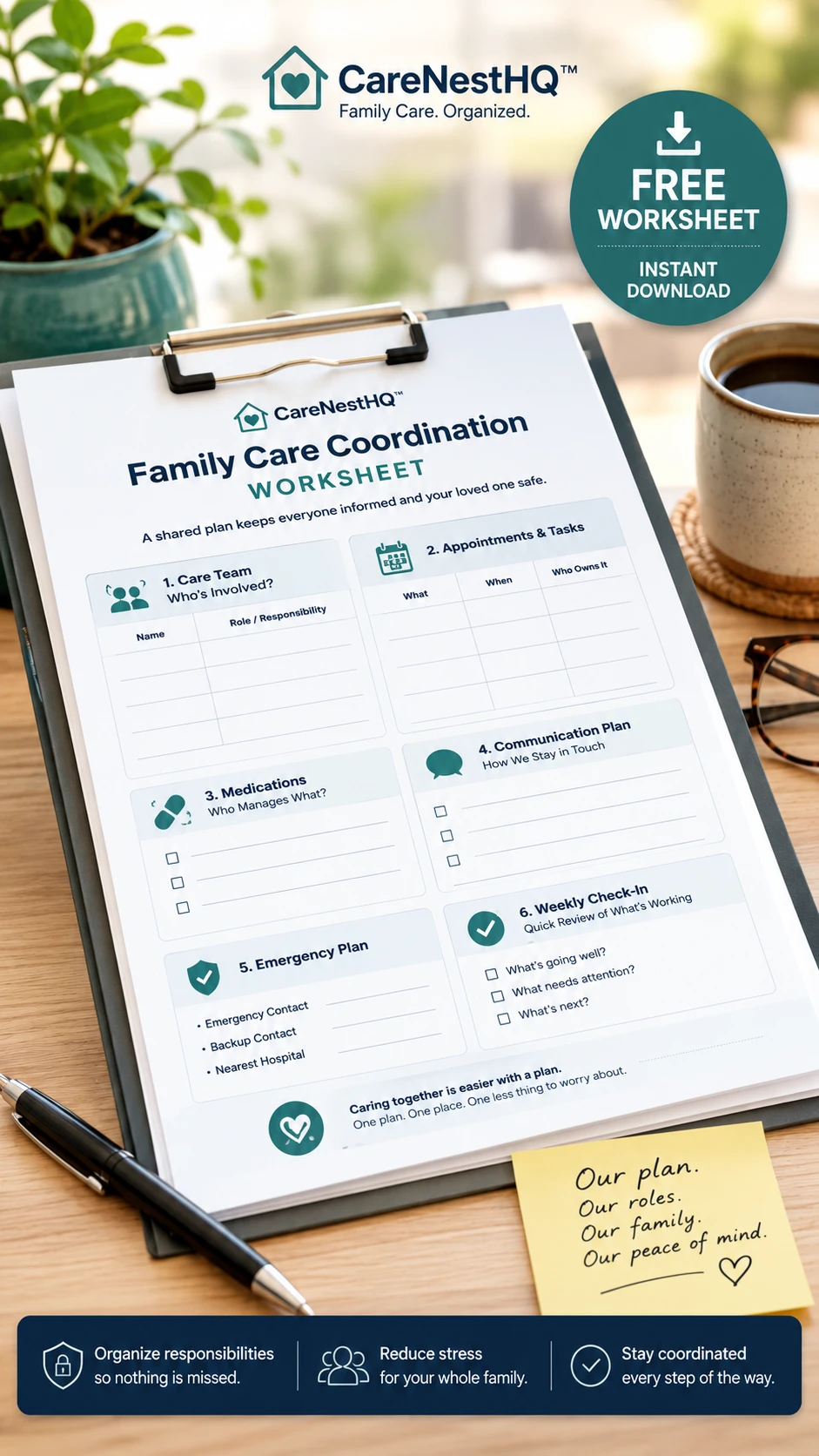
Printable worksheet for family roles, emergency contacts, medication ownership, appointment ownership, weekly planner, and escalation rules after hospital discharge.
See also the Family Medical Information Readiness Report 2026 for baseline preparedness data.
Permanent CareNestHQ intellectual property framework for family care coordination.
PublishedPermanent CareNestHQ intellectual property framework for family care coordination.
PublishedPermanent CareNestHQ intellectual property framework for family care coordination.
PublishedPermanent CareNestHQ intellectual property framework for family care coordination.
PublishedPermanent CareNestHQ intellectual property framework for family care coordination.
PublishedPermanent CareNestHQ intellectual property framework for family care coordination.
PublishedPermanent CareNestHQ intellectual property framework for family care coordination.
Unnamed ownership and no weekly review — not lack of love.
Remote sibling maintains daily contact without owning deliverables.
Nearest sibling absorbs all care because no matrix assigns remote tasks.
One sibling excluded because updates flow through side texts.
Own remote deliverables with due dates instead of status calls.
No. CFM depersonalizes conflict; the fix is structural.
Switchboard → FRM; Silent Third → FCC; Hero Local → FRM + WCOR.
NIA and AHA document caregiver stress; CFM adds multi-sibling diagnosis.